Does Gold Lose Value? What Every Investor and Seller Should Know


Gold is often regarded as a safe haven, a hedge against inflation, and a store of value. Yet anyone who watches the charts knows one thing: gold prices fluctuate, sometimes even sharply, and in ways that can test an investor’s confidence.
That raises an unsettling question for investors and sellers alike: if gold can drop dramatically in certain cycles, does gold lose value in the long run? Or does it preserve purchasing power despite short-term swings?
This article breaks down why gold rises and falls, how short-term volatility differs from long-term value, and what historical gold price patterns and forecasts suggest for those deciding whether to hold or sell.
Understanding Gold’s Price Behavior
The price of gold does not move randomly. Factors such as inflation, interest rates, geopolitical events, and basic supply and demand all influence price movements. If one understands these forces, one also understands why gold sometimes rises sharply and sometimes declines.
What drives gold prices?
Three main forces influence gold prices: economic indicators, safe-haven demand, and basic supply and demand.
Economic indicators
Economic indicators include factors like inflation, interest rates, and currency strength:
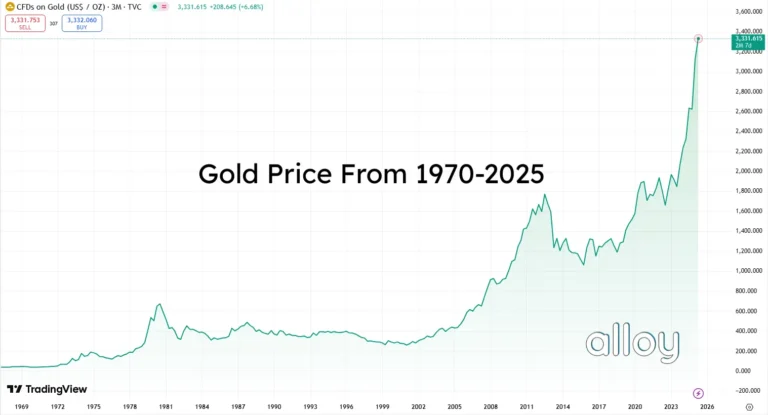
- Inflation: Inflation often pushes investors toward gold, as it is seen as a hedge against declining purchasing power. For example, during the high inflation period of the late 1970s, gold rose from roughly $200 per ounce in September 1978 to nearly $750 per ounce in January 1980.
- Interest rates: Rising real interest rates can weigh on gold prices. When real yields are high, the opportunity cost of holding gold (which doesn’t pay interest or dividends) increases. This drives investors toward bonds and other income-generating instruments, reducing gold demand and its price.
- Currency strength: When the U.S. dollar strengthens, gold often becomes more expensive for global buyers and may decline in dollar terms. When the dollar weakens, gold typically becomes more attractive and tends to rise.
Safe‑haven demand
When investors fear or worry about banking systems, stock markets, or geopolitical conflict, they prioritize capital preservation over risk-taking. As a result, demand for more stable assets, such as gold, often increases.
During the 2008 financial crisis, gold briefly fell to around $720 per ounce in late 2008 as investors rushed to raise cash. But as uncertainty around banks and the economy deepened, demand for gold picked up. Prices rebounded strongly, eventually reaching as high as $1,800 per ounce in the mid 2011s.
A similar pattern appeared during the early months of the COVID-19 pandemic in 2020. As markets panicked, uncertainty spread, and governments rolled out aggressive stimulus measures, safe-haven demand for gold surged.
By August 2020, gold prices had climbed past $1,900 per ounce, up from around $1,500 per ounce just months earlier.
Supply and demand fundamentals

At the end of the day, gold prices remain subject to basic supply and demand.
In gold’s case, supply grows slowly because mining is capital-intensive, time-consuming, and geographically constrained. New discoveries are rare, and annual global mine production typically increases only modestly. This limits sudden supply surges that could flood the market and depress prices.
On the demand side, central banks hold large reserves and have been net buyers in recent years, creating steady institutional demand. In addition, more than half of all gold ever mined remains in jewelry, reducing the amount of freely tradable supply.
When central banks buy, or investor demand rises during periods of uncertainty, prices tend to rise because supply cannot expand quickly enough to meet that demand.
On the other hand, when investment demand weakens and selling increases, prices can fall even though physical supply remains relatively stable.
Volatility vs. long‑term trends
Clearly, gold prices move for many reasons. But to really understand those movements, it helps to separate two things:
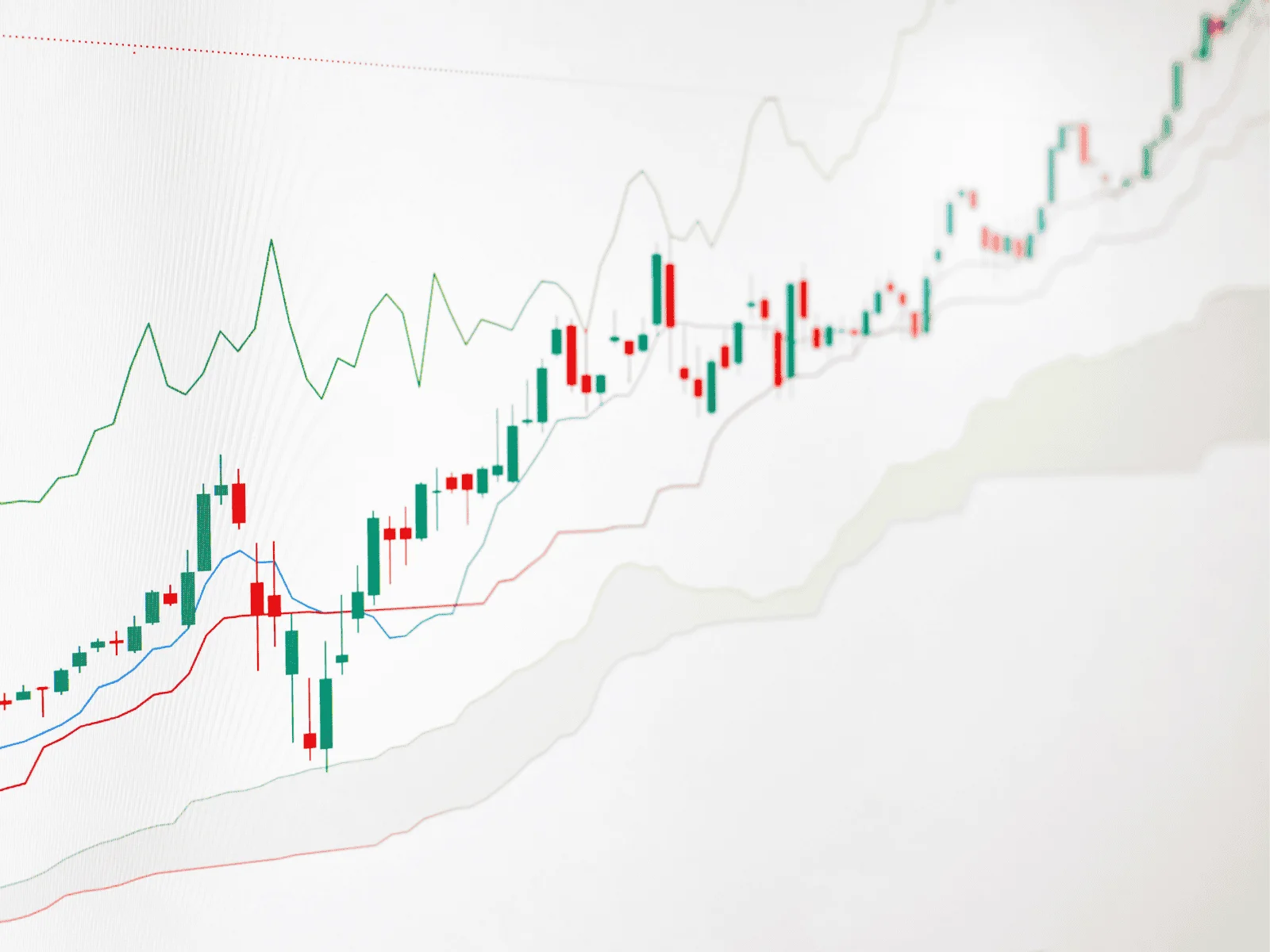
- Volatility refers to the short-term swings that can happen over weeks, months, or even a few years. These movements can be triggered by interest rate changes, a strong dollar, sudden market downturn, or unforeseen political developments that cause investors to reposition their money.
For example, recent news surrounding President Trump’s Federal Reserve chair nomination triggered a sharp sell-off in gold and silver within days. These kinds of reactions can be fast and dramatic, but they do not automatically mean gold’s long-term value has changed.
- Long-term trend, on the other hand, reflects how gold behaves across full economic cycles and decades. This trend is shaped by broader forces like inflation, money supply growth, and changes in currency purchasing power.
This distinction matters because confusing volatility with trend can lead to emotional decisions. A temporary drop may feel like a lasting decline, even when the broader trajectory remains intact.
History shows this clearly. After peaking near $1,900 in 2011, gold fell to around $1,050 by 2015, a decline of roughly 45 percent. Investors who bought at the peak and sold near the bottom locked in losses driven by short-term volatility.
However, in the years that followed, gold recovered and eventually moved above $2,000 by 2024. Similar cycles occurred after the 1980 peak and following the 2008 financial crisis – sharp pullbacks were followed by consolidation and later recovery within a broader upward pattern.
Over extended periods, gold has often preserved purchasing power even though the path hasn’t been smooth.
Does Gold Ever Lose Value?
Yes, gold can lose value in both the short term and over multi‑year periods. So, the question is not whether gold can go down in value, but how deep the decline goes, how long it lasts, and whether value is permanently destroyed.
Temporary vs. sustained declines
A short-term price drop is not the same as a permanent loss of value. Gold, like any asset, moves in cycles. Gold prices can fall because of interest rate hikes, a strong dollar, or shifting investor sentiment.
A temporary decline usually follows a strong rally. For example, in 2013, gold fell roughly 28 percent in a single year after the Federal Reserve signaled tighter policy.
That drop came after a decade-long climb from around $250 in 2001 to nearly $1,900 in 2011. The fall was sharp, but it occurred within a larger multi-year cycle rather than signaling the end of gold’s long-term role.
A sustained decline, on the other hand, unfolds over several years and reflects a broader shift in economic conditions. After peaking near $1,900 in 2011, gold declined to roughly $1,050 by late 2015; about a 45 percent drop over four years.
Real value vs. nominal value
Nominal value is simply the dollar price of gold. Real value adjusts that price for inflation.
This distinction matters because gold can rise in dollar terms and still lose purchasing power if inflation rises faster. Conversely, it can appear flat in nominal terms yet hold purchasing power better than cash.
For example, gold traded at around $660 per ounce in 1980. It did not surpass that nominal price again until 2007. On paper, it looked stagnant for nearly three decades.
However, when adjusted for inflation, the 1980 peak equals roughly $2,800 in today’s dollars. So even when gold reached $1,000 in 2007, it was still well below its real purchasing-power high.
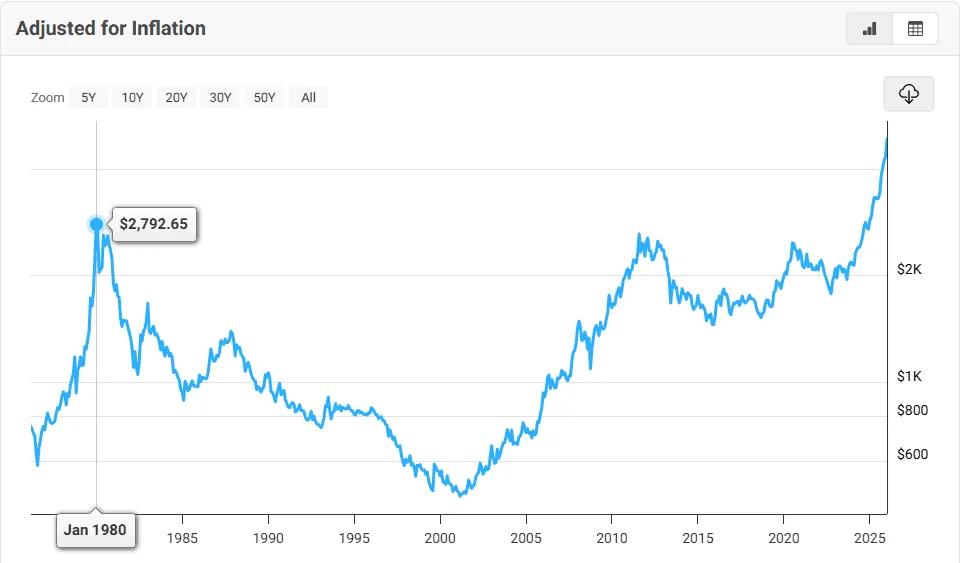
That said, when gold “loses value” in real terms, it means inflation has outpaced its price growth. And when gold truly preserves value, it rises enough to keep up with, or exceed, inflation over time.
Will Gold Lose Its Value in the Future?
Gold can decline in value in future cycles, but a permanent collapse is unlikely, considering its past performance and its long-standing role in the global financial system. Its future value depends largely on interest rates, inflation trends, currency stability, and investor demand.
Expert projections & market conditions
For anyone wondering, “Are gold prices expected to drop?”, it’s worth looking at what experts were saying just months ago, and how quickly the market moved.
By the end of 2025, most major institutions did not forecast a collapse in gold prices. In fact, the consensus view was that prices would remain elevated into 2026, supported by global uncertainty and strong demand from central banks.
A Reuters poll of analysts and traders at the time projected a median forecast of about $4,746.50 per ounce in 2026.
Other reputable institutions shared a comparable view:
- Deutsche Bank raised its 2026 forecast to around $4,450 per ounce, citing ongoing central bank purchases and investor flows as structural support.
- JPMorgan expected prices near $4,000 in early to mid-2026
- UBS projected gold around $4,200 per ounce by mid-2026
- HSBC analysts suggested gold could reach around $5,000 per ounce in 2026
Notably, gold has since surpassed many of those projections, trading above $5,000 per ounce. What was once considered an upper-range forecast has already been realized, and in some cases exceeded.
The World Gold Council’s 2026 outlook offers a more measured perspective, noting that while gold’s rally was supported by uncertainty and currency weakness, stronger global growth or tighter monetary policy could moderate momentum.
The takeaway is less about the exact number and more about the direction. Even conservative forecasts anticipated continued strength rather than a sharp decline. And as recent price action shows, gold can move faster and further than many models predict.
That said, no forecast is a guarantee. Gold remains sensitive to interest rates, geopolitical risk, inflation expectations, and central bank behavior. As history has shown, economic shifts can influence where it heads next.
Conditions that support gold’s long‑term value
Many long-term gold forecasts are based on broader forces that have historically supported prices.
- Inflation fears: When the cost of living rises quickly, interest in gold tends to pick up. We saw this in the late 1970s and again in 2020–2022, when many turned to gold as a hedge against weakening currencies.
- Currency debasement and monetary expansion: Since the early 1970s, when the U.S. left the gold standard, paper currencies have gradually lost purchasing power. Gold’s supply grows slowly and cannot be printed, which is part of why many see it as a long-term store of value.
- Central bank reserve accumulation: In recent years, central banks have increased their gold reserves as part of broader diversification efforts. Since these institutions tend to hold for the long term, their purchases can provide a steady underlying demand.
Should I Hold or Sell My Gold Now?
Whether someone should hold or sell their gold depends on timing, personal goals, and their broader financial position. Gold doesn’t move the same way in every economic cycle, so the right decision all comes down to each individual situation.
| Consider selling when… | Consider holding when… |
|---|---|
|
|
- Gold is trading near record or historical highs after a strong multi-year run
- You bought low and want to capitalize on current high prices
- You need liquidity for debt, emergencies, or another investment opportunity
- Interest rates are rising and alternative investments offer attractive after-inflation returns
- You bought near recent highs and want to lock in gains rather than risk a correction
- You believe the current cycle may be near a peak
- Inflation remains elevated and you want protection against purchasing power erosion
- Economic uncertainty is high and safe-haven demand could strengthen
- You are holding gold as part of long-term diversification
- You are not under financial pressure to convert gold into cash
- You are focused on long-term value rather than short-term price swings
Key factors to consider
Personal investment goals
Why did someone buy gold in the first place? Why are they holding onto it now? Are they keeping it as a long-term hedge against inflation and currency risk, or considering selling because prices have risen?
Long-term holders usually accept ups and downs and think in years, not months. But if the piece is simply sitting in a drawer and someone is waiting for the “right” moment, timing risk becomes real, especially if prices are already near recent highs.
Gold price trends and timing
Gold tends to move in cycles that can last several years. People who bought near major peaks, like in 1980 or 2011, had to wait a long time before prices fully recovered.
If gold is trading near historical highs today, people might want to ask whether it is a good time to sell part of what they’re holding rather than wait and hope for even higher prices.
Personal financial situations
If someone needs money for debt, an emergency, or another opportunity, selling now and locking in gains could make sense. If they’re not under pressure and the piece doesn’t need to be converted to cash, there’s no rule requiring them to sell right away.
Signals that might favor selling

Sometimes the market and a personal situation line up in a way that makes selling worth considering. Here are a few of those situations:
- Peak price conditions: When gold trades near record highs after a strong multi-year run, history shows prices don’t always keep rising. After the 2011 peak near $1,900, for example, gold fell sharply over the following four years.
- Need for liquidity: If someone needs funds for a home purchase, business investment, or debt repayment, converting gold into cash during strong price conditions can be financially prudent.
- More attractive alternative investments: If interest rates are rising and savings accounts, bonds, or other investments are offering solid returns after inflation, it may make sense to shift part of your gold into assets that generate income rather than simply sit in storage.
Signals that might favor holding
There are also times when holding onto gold may make more sense than selling. Here are a few situations where waiting could be reasonable:
- Rising inflation: When inflation stays high for a while, gold has often held its value better than cash. During past inflationary periods, many people kept their gold to protect their purchasing power.
- Economic uncertainty: In recessions, financial crises, or periods of geopolitical instability, gold has often attracted buyers looking for security. This was evident in 2008 and again in 2020, when uncertainty drove demand higher.
- Diversification: If gold is part of a broader financial cushion, holding some may help balance risk. Gold doesn’t always move in the same direction as stocks during turbulent periods, which can provide a layer of stability.
Seasonal and Cyclical Patterns
In which month is the gold price lowest?
There isn’t one specific month when gold is always at its lowest. However, experts at Traders Union have found that gold prices soften during spring and summer, with March through July occasionally showing weaker pricing than the rest of the year.
That means anyone looking to sell may want to pay closer attention to late summer and year-end pricing, particularly from late August through December.
Still, seasonal patterns are not guarantees, and they shouldn’t be the sole basis for a major selling decision. Larger forces, such as inflation trends, interest rates, or global events, can easily outweigh any calendar effect.
Other cycles that affect gold prices

Beyond seasonality, gold is heavily influenced by broader economic cycles.
Interest rate cycles
When interest rates rise, investors can earn more by keeping money in savings accounts or buying government bonds. In those periods, fewer people rush to buy gold, which can soften demand and put pressure on prices.
When rates start falling, the opposite can happen. Returns on cash and bonds shrink, and gold becomes more appealing as a store of value. Demand often strengthens, which can support higher prices.
People don’t need to track economic data daily to understand this cycle. Just watch interest rate headlines and the overall direction of gold prices, and spot if it follows one of the two patterns described earlier.
Quarterly and regional demand fluctuations
In countries like India and China, gold jewelry is closely tied to festivals, weddings, and gift-giving traditions.
In India, demand often increases ahead of major celebrations such as Diwali and the wedding season, when gold is considered both auspicious and a symbol of prosperity.
In China, buying activity typically rises around the Lunar New Year and other festive periods, when gold jewelry and small bullion pieces (e.g., gold coins) are commonly given as gifts.
These concentrated buying windows can boost quarterly demand figures and, at times, support gold prices.
So, Is Now a Good Time to Sell?
Gold does not move in a straight line. It rises during uncertainty, softens during tightening cycles, strengthens during demand surges, and sometimes stalls when momentum fades.
Seasonal patterns may provide clues. Interest rate cycles may create pressure. Festival demand in major markets may temporarily lift prices. But none of these forces guarantees that a higher price is coming next month.
That’s why waiting for the “perfect” peak can be difficult.
If gold is already trading near historical highs, some sellers choose to lock in gains rather than risk a pullback. Others prefer to hold, especially if gold plays a long-term role in their portfolio.
The key question is not whether gold will move again; it will. The question is whether today’s price meets personal financial goals.
If someone’s gold is sitting unused and current prices already represent strong gains, selling part of it can be a strategic decision rather than an emotional one.
Ready to Sell While Prices Are Strong?
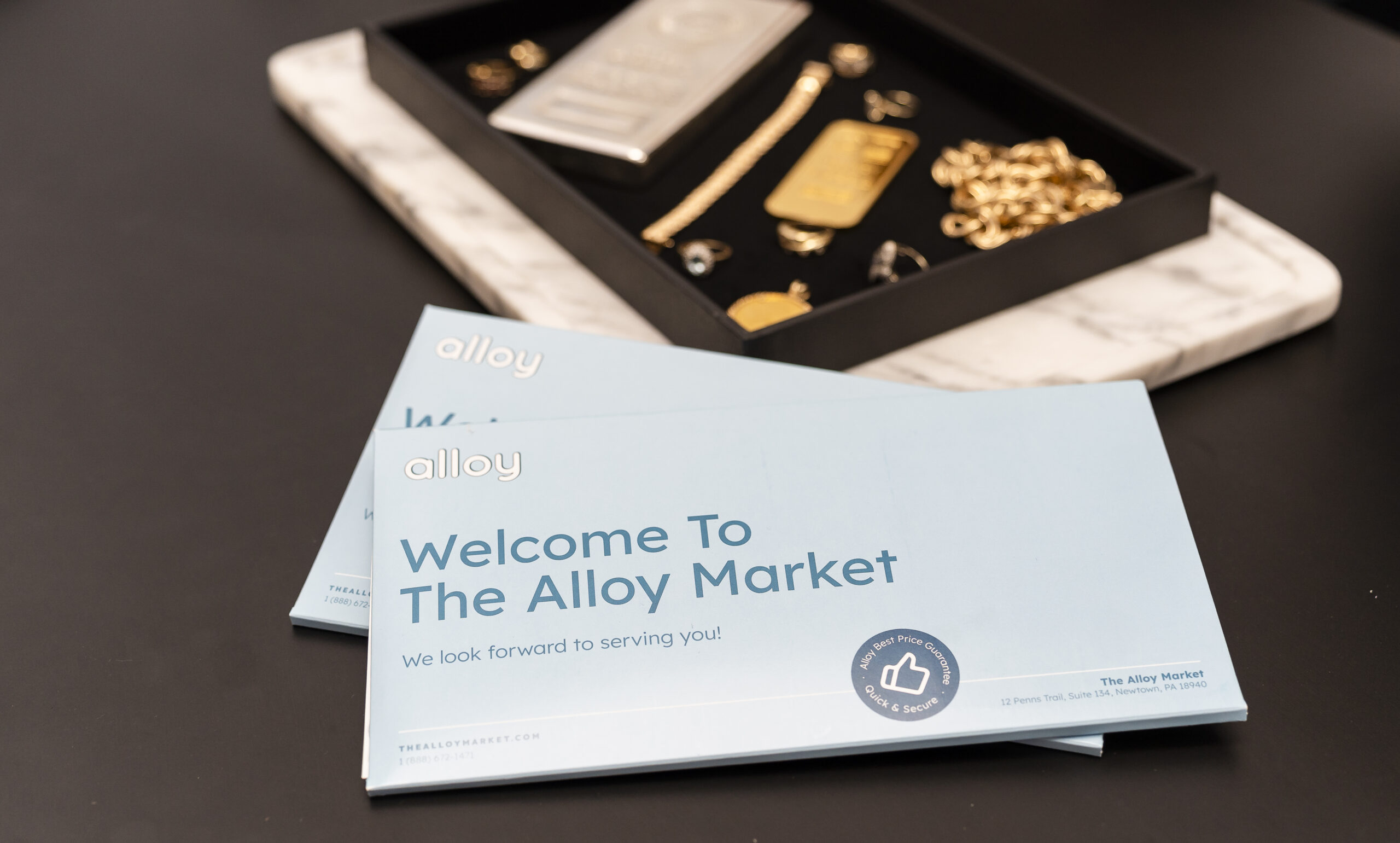
If selling now makes sense for your personal situation, the Alloy Market makes it simple to do so from the comfort of your own home.
Request a free evaluation kit and use the provided postage-paid parcel to pack your items and ship them to us. We’ll cover insurance and tracking while your items are in transit.
When your items arrive, we test them for purity and weight, and send you an itemized purchase offer based on the live market value. Accept, and we’ll issue your payment the same day. If you choose to decline, we’ll send your items back at no cost to you.
Join the thousands of happy customers who have made Alloy their go-to precious metal buyer. Get started today by requesting your kit now.