
5 Dollar Gold Coin Value: What They’re Worth in 2026


The value of the half eagle comes from two sources: the coin’s melt value (the actual gold content) and its collector (numismatic) value. Prices fluctuate with the gold market and collector demand, so a coin might be worth only its weight in gold or far more if it’s a rare or high-grade piece. Keep reading to learn how to determine 5 dollar gold coin value.
In a nutshell:
A $5 gold coin can be worth anywhere from its melt value to tens of thousands of dollars, depending on the type, date, condition, and rarity. The gold price today, , is approximately $ per troy ounce, which sets the baseline gold melt value for most $5 gold coins. Condition, mint mark, authenticity, and market demand all play a critical role in pricing. Before selling, it’s important to identify the coin, calculate melt value, assess condition, and compare offers, since where and how one sells can significantly affect the final payout.
What is the Value of a $5 Gold Coin?
Melt value is the starting point for determining the value of a $5 gold coin.
The classic half eagles minted before 1933 contain about 0.24187 troy ounces of pure gold. With gold prices around $4,300 per ounce in December 2025, that’s about $1,040 per coin in melt value alone.

Modern $5 American Gold Eagles are bullion coins that first appeared in 1986 and contain only 0.10 troy ounces of gold, at current gold prices, which puts their melt value at about $430.
Modern American Gold Eagles use a different valuation model than the historic half eagles, even though both say “$5” on them. The modern Eagles are fractional bullion, meaning their value moves almost entirely with the spot price of gold. They don’t carry the same numismatic value as older coins.
Is a $5 Gold Coin Rare?
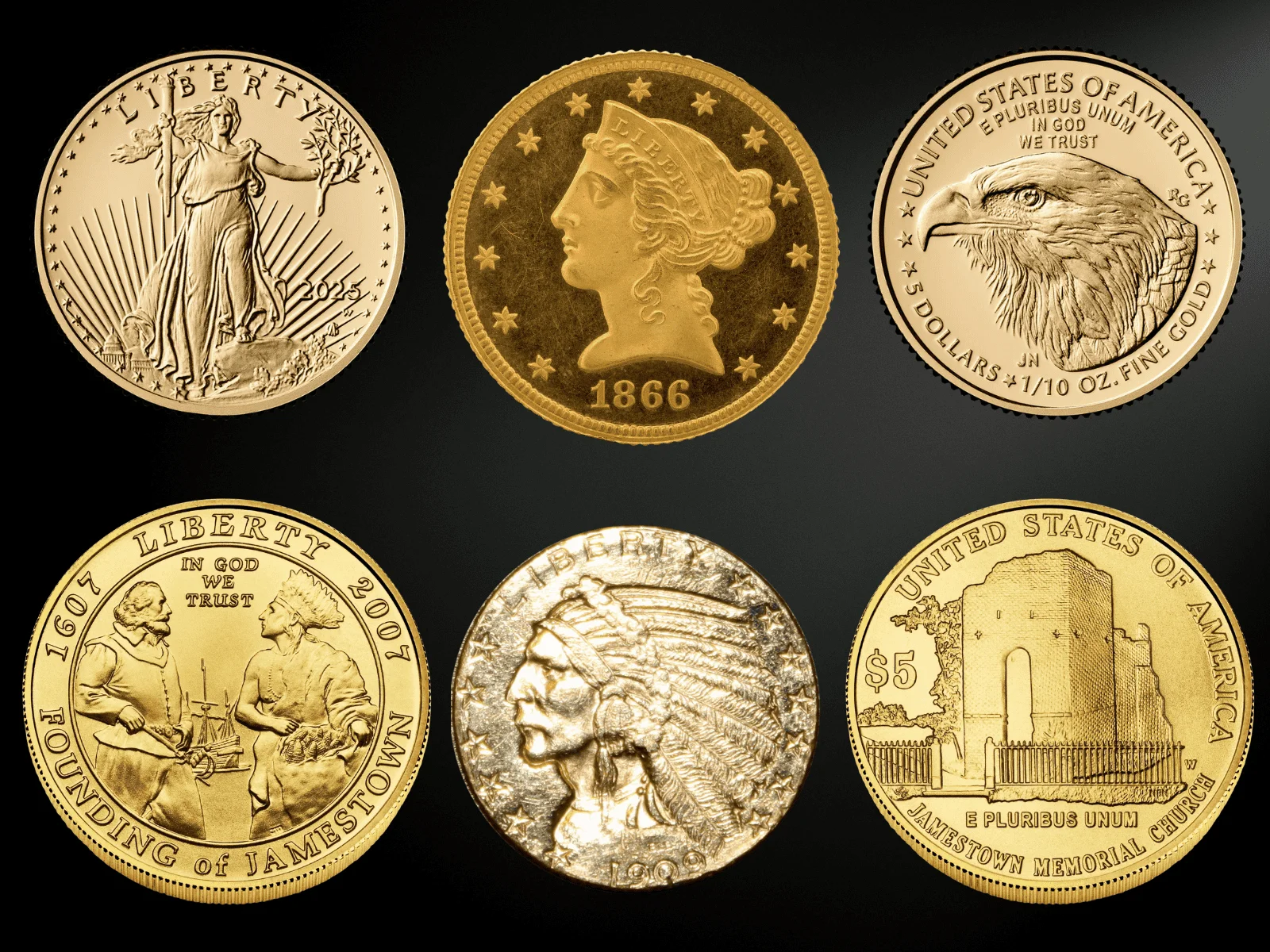
Specific issues are not rare at all; millions were minted and have survived, while some dates are incredibly scarce. A classic rare coin is the 1909-O Indian Head $5 gold piece, which had a mintage of only 34,000. Very few have survived, making it worth far more than common-date coins in typical condition. The image below is of an Indian Head in the same series, but not a 1909-O.
License: https://creativecommons.org/licenses/by-sa/3.0/
Types of Five-Dollar Gold Coins and How to Identify Them
Over the years, the US Mint produced several types of $5 gold coins.
Liberty Head Half Eagle (1839 to 1908)
Christian Gobrecht designed this coin to feature Lady Liberty’s head wearing a coronet on the obverse and a heraldic eagle on the reverse. Early issues (1839-1866) lack the mottoes, while later ones include “In God We Trust.” Liberty $5 gold coins were struck at seven different mints, which is more than any other U.S. coin, including Philadelphia, New Orleans, San Francisco, and the branch mints at Charlotte (C), Dahlonega (D before 1861), Carson City (CC), and Denver (D starting 1906).
Many dates are common, but this long series has notable rarities (for example, 1854-S with only 268 struck, or certain low-mintage Charlotte and Dahlonega issues). In circulated grades, most Liberty $5 coins trade near their gold value ($983 at current prices), while well-preserved or rare-date pieces can fetch thousands.
Indian Head Half Eagle (1908 to 1929)
This $5 coin, designed by Bela Lyon Pratt, is unique for its incuse design. The image of an Indigenous chief on the obverse and a standing eagle on the reverse are sunken into the coin’s surface rather than raised.
The Indian Head $5 was produced at Philadelphia, Denver, San Francisco, and briefly at New Orleans (1909-O). Its incuse design is popular, but it also means counterfeits are shockingly common. Even experienced collectors can find it hard to detect fakes.
Some key identifiers are the motto “In God We Trust” on the reverse and the sharp incuse details. Most dates are semi-common, but 1909-O, 1911-D, and the final-year 1929 are key dates with high values. A circulated 1908 Indian $5 might be around $800, whereas a 1929 can reach five figures at auction.
A genuine Indian $5 coin should weigh about 8.36 grams and be 21.6 mm in diameter.
Modern Five Dollar Gold Commemoratives (1986 to present)
The US Mint resumed producing $5 gold coins in 1986 with the Statue of Liberty commemorative. These modern pieces are 90% gold and 10% copper, with 0.2419 troy ounces of gold, much like their 19th-century predecessors.
Each commemorative has a unique design honoring an event or person, such as the 1986 Statue of Liberty or the Founding of Jamestown (above). Because of this, the coins are usually uncirculated or proof finishes aimed squarely at collectors.
Anything dated 1986 or later, with a commemorative theme or inscriptions, will likely be one of these modern coins. And unless an issue has a low mintage or perfect grade, the collector premium is relatively small, and they are valued mainly as fractional gold bullion, which is why most trade close to their melt value.
Gold Content and $5 Coin Melt Value
How much gold is in a $5 coin depends on the type of coin.
Pre-1933 $5 Liberty and Indian Heads are historic half eagles made up of 90% gold and 10% copper alloy, and weigh 8.359 grams, which equals 0.24187 troy ounces of pure gold. Modern $5 gold commemoratives have the same composition and gold content.
That’s about 7.52 grams of gold in each coin.
Modern $5 American Gold Eagle coins are treated as bullion coins and contain 0.1000 troy ounce of gold (3.11 grams). It’s 91.67% gold (22 karat) with a total weight of 3.93g, but the gold content is exactly one-tenth of an ounce.
If someone wants to know how much the melt value for each coin is, here is the formula for it:
Melt Value = (Gold content in troy oz) × (Spot price of gold per oz).
If gold is $4,300/oz, a classic half eagle (0.24187 oz) has 0.24187 × $4,300 = $1,040 in gold, whereas a 1/10 oz Eagle has 0.1 × $4,300 = $430. If gold prices change, the melt values change proportionally.
Keep in mind, this is the base value. Payouts will vary depending on the buyer. Private buyers may be willing to pay the full melt value, while dedicated precious metal dealers may only pay a percentage to account for operating expenses.
Factors That Affect a Coin’s Value
Gold content sets the floor, and everything else determines the premium above melt value.
Condition and Grade

Coins are graded on a 1-70 scale, with higher grades indicating less wear and significantly greater value. A coin in uncirculated (Mint State) condition can be worth multiples of the same coin in well-worn condition. This higher valuation reflects collectors’ willingness to pay for the preservation of the coin; the better its condition, the more they are willing to pay. It is also why expert grading is so prevalent with high-value coins.
Mint Mark and Rarity
Certain mints and years had low production, making those coins scarce and valuable. Rarer coins equal higher value.
Historical Significance
While history alone doesn’t guarantee the price of the coin will increase, it often correlates with demand if the coin is also scarce. That’s because coins with a story or significance can attract way more interest from collectors.
Market Demand
Having the best, most unique coin in the world is worth nothing if no one is interested in purchasing it.
Authenticity and Common Counterfeit Concerns
A genuine rare coin is valuable, while a replica is essentially worthless.
Unfortunately, counterfeits of $5 gold coins exist. Lots of them. Especially the Indian Head since its incuse design has long been a “counterfeiter’s paradise.”
Many fakes are even marked “COPY” as required by law, which should be pretty easy to spot, but deceptive forgeries are not. For these, additional features of the coin may need to be examined. Some red flags that indicate a fake include wrong weight, wrong sizing, odd color/luster, blurry details, wrong fonts, and magnetism (gold isn’t magnetic, so if the coin sticks to a magnet, it’s fake).
That’s why collectors and dealers will pay more for coins certified by Numismatic Guaranty Company (NGC) or the Professional Coin Grading Service (PCGS); their grading services help guarantee a coin’s authenticity.
How to Sell a Five-Dollar Gold Coin
Here are the best options for selling a $5 gold coin, and what to expect from each.
Online Gold Buyers
Online gold buyers like The Alloy Market buy gold coins via mail.

How it works:
- Request a free insured mailer kit
- Ship the coin
- Receive an offer
If the seller likes the offer, great. If not, they will receive their gold back. Alloy covers shipping and insurance (insured up to $25k-$100k), so it’s low-risk.
Best for: melt value coins & convenience
Local Coin Shops
If a $5 coin has collectible value, a local coin shop may be able to offer more money. Sellers will get an immediate evaluation and payment from a knowledgeable dealer who might be willing to pay extra for a rare date or high-grade coin. Unfortunately, if the coin is only worth its melt value, it’s not the best way to profit, since shops will offer only a percentage of the coin’s value so they can still make a profit.
Best for: rare coins
Pawn Shops

Pawn shops are a last resort for selling a $5 gold coin. The only benefit to them is that they give instant cash. Pawn shops are notorious for offering low percentages of value, sometimes only 20-50% of the gold’s actual worth. Their business model is to resell for profit, so they try to buy products at the lowest possible price. So, unless a seller has no other option, they are likely going to get a much lower offer at a pawn shop.
Best for: fast cash
Auctions or Consignment
If someone believes their $5 gold coin is very rare, selling through a major auction house or on consignment can maximize profits. Auction houses can put a coin in front of thousands of bidders, which can drive the price well above melt value.
The upside is the highest potential price for exceptional coins. The downsides include fees/commissions of around 10-20%. Plus, it can take weeks to sell and for the money to clear.
Best for: extremely rare coins
Steps to Selling 5 Dollar Gold Coins
- Step 1: Identify the type of coin. To do so, check the date, design (Liberty, Indian, or modern), and any mint mark.
- Step 2: Check the gold content. Pre-1933 coins hold around 0.24187 troy ounces, while American Gold Eagles have 0.10 ounces.
- Step 3: Look up the latest gold price and calculate the coin’s melt value using the formula above. Here’s a simple gold melt value calculator tool to make it even easier.
- Step 4: Examine the coin’s condition, or have it graded by a professional such as NGC or PCGS.
- Step 5: Don’t jump at the first offer received. Shop around and get quotes from multiple buyers.
- Step 6: Based on the offers and the selling priorities, decide where to sell. If one buyer offered the highest price, it’s likely the best bet.
Selling Gold Coins to The Alloy Market
If you’ve got some gold coins without collectible value, but you’d like to sell them for their gold content, The Alloy Market makes it easy to do so. Start by requesting a free evaluation kit, and we’ll ship it directly to you. Inside, you’ll find a postage-paid parcel to pack your gold coins and mail them directly to us. We cover insurance and tracking so your valuables are safe in transit.
Once they arrive with us, our team of professionals will evaluate and verify the pieces and send you a detailed offer. When you accept, we initiate payment on the same business day. Join other happy customers and choose Alloy as your go-to precious metal buyer.


