At $15 Trillion, Gold Jewelry Is Now Worth More Than the World’s Largest Tech Companies Combined

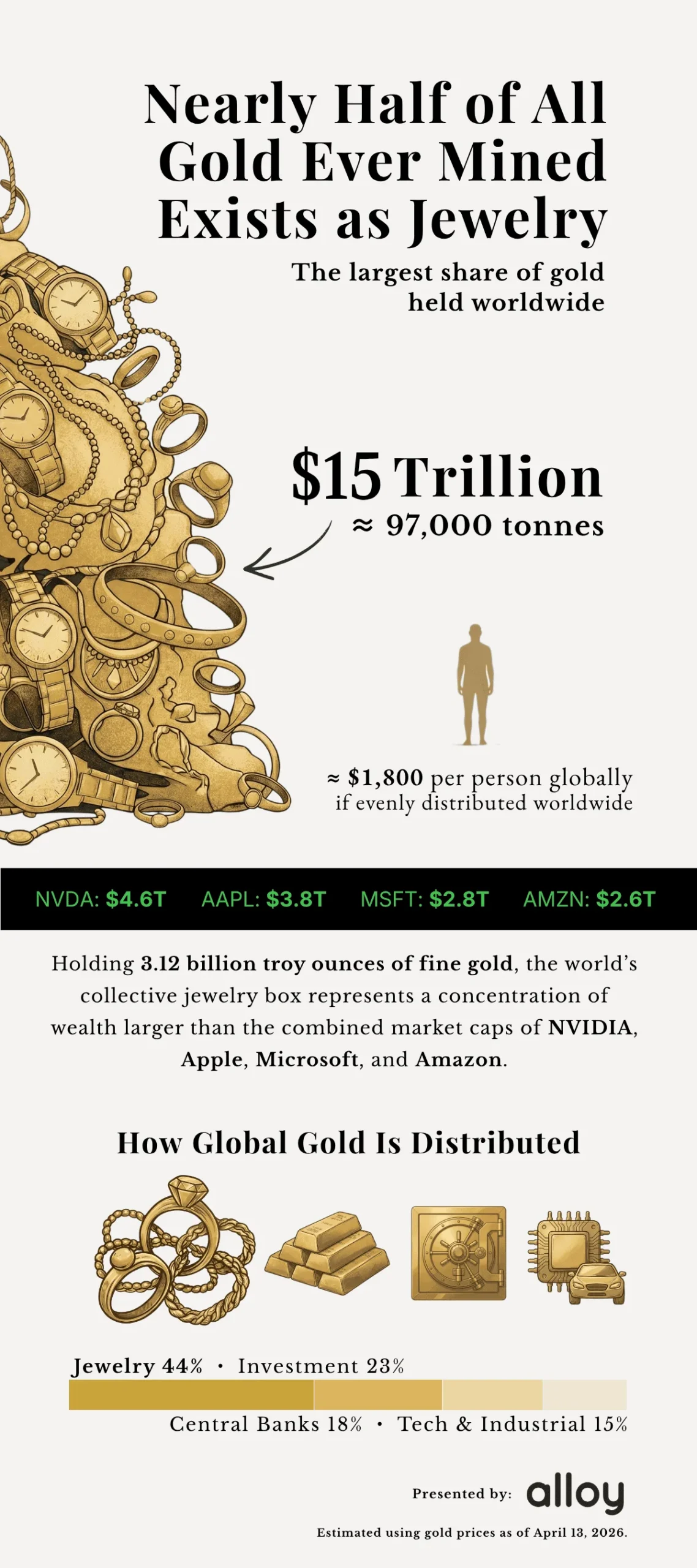
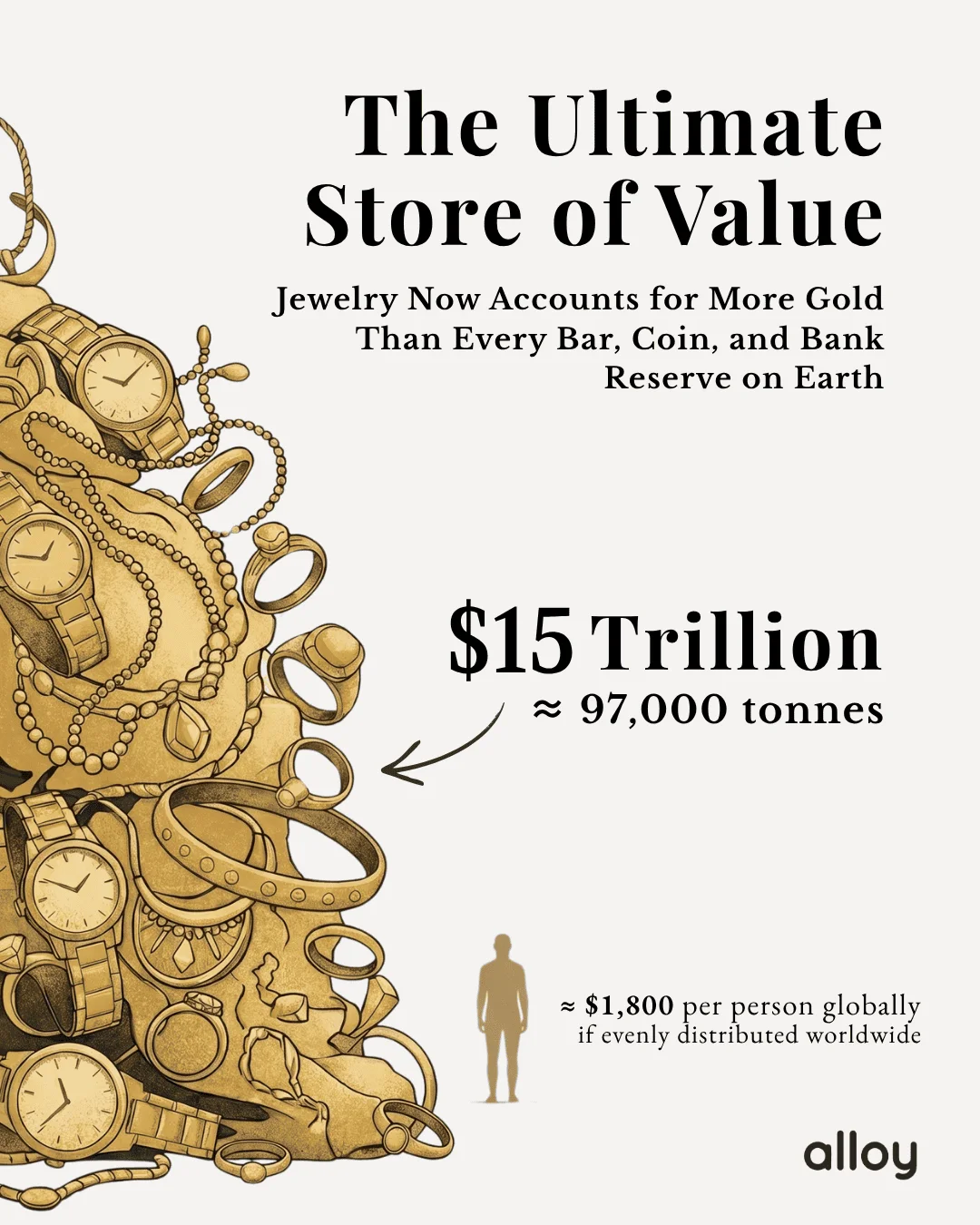
When people think of gold stores, their minds often go straight to bars and coins held by large banks. It may come as a surprise, then, that nearly half of all gold ever mined exists as jewelry. Of the roughly 220,000 tonnes of gold mined throughout history, jewelry accounts for about 44%, or nearly 97,000 tonnes.
Unlike other assets, gold is often worn, not just stored, and that raises an important question: how much is all of that gold actually worth in today’s dollars?
At a Glance:
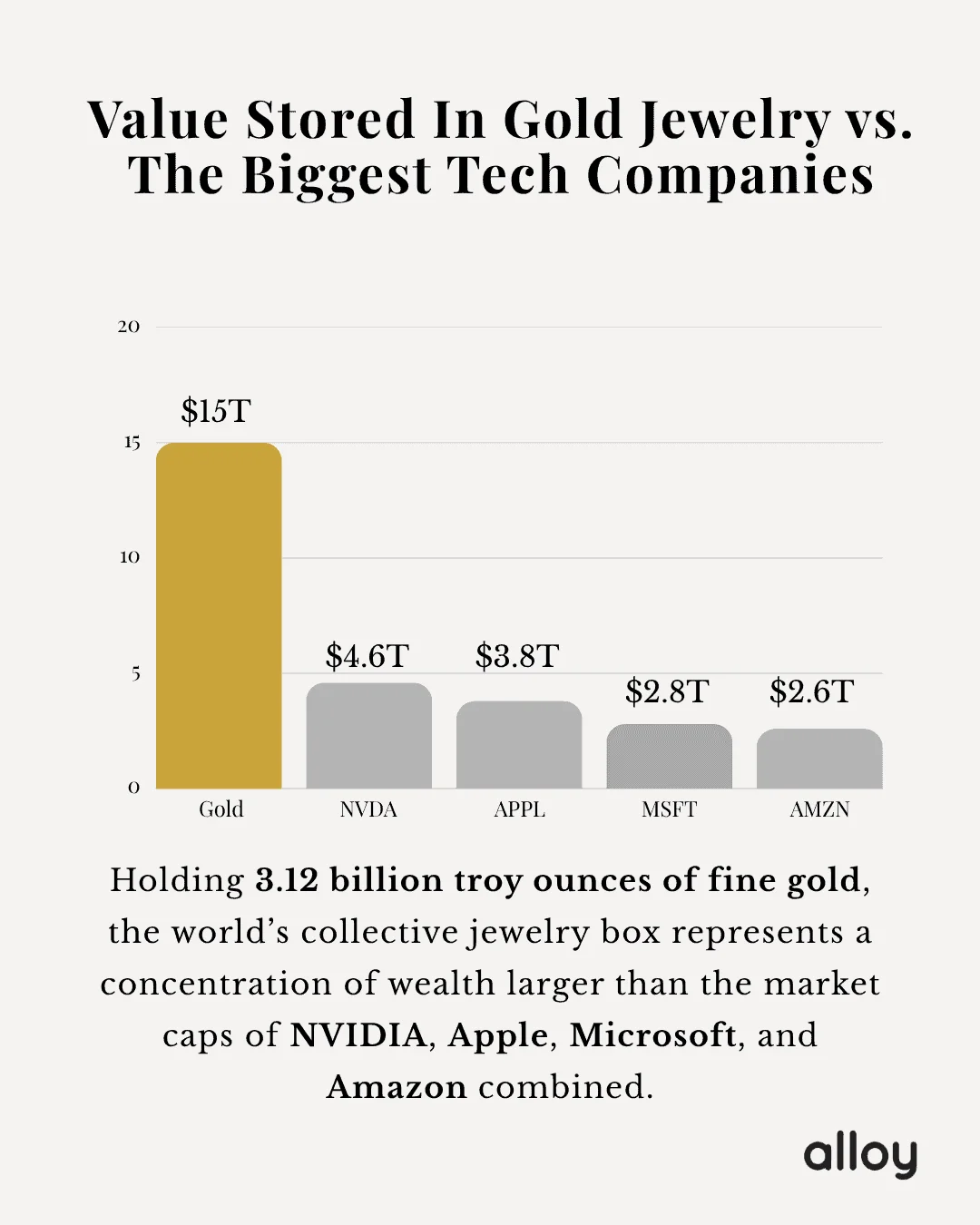
Holding 3.12 billion troy ounces of fine gold, the world’s collective jewelry box represents a concentration of wealth larger than the combined market caps of the world’s four largest companies. At a valuation of nearly $15 trillion, this private store of gold outweighs the combined market value of NVIDIA ($4.6T), Apple ($3.8T), Microsoft ($2.8T), and Amazon ($2.6T).
What Is All That Gold Jewelry Worth?
(Data as of April 2026)

If jewelry holds an estimated 97,000 tonnes of the world’s gold, what does that equate to in monetary terms? Here’s what that looks like.
- 97,000 tonnes is equal to approximately 3.12 billion troy ounces
- The current spot price of 24K gold is $152.94 per gram
Based on these figures, the total metal value of all gold jewelry worldwide as of April 14, 2026, is approximately $14.83 trillion. This places gold jewelry among the world’s largest concentrations of wealth.
Note: While the analysis in this report is based on a static benchmark price as of April 13, 2026, the value of gold moves in real time. The ticker below reflects the current market value of the world’s jewelry gold based on the latest spot prices.
Importantly, this estimate reflects only the intrinsic metal value, not retail pricing. Jewelry is often sold at markups ranging from 100% to 800%, meaning the total retail value of that gold could be significantly higher, potentially between $29.6 trillion and $74.1 trillion.
If Gold Jewelry Were a Company
To put that into perspective, the intrinsic value of the world’s jewelry box dwarfs the “Magnificent Seven” tech giants. If gold jewelry were a publicly traded company, its market cap would be:
- 3.3x larger than NVIDIA ($4.5T)
- 3.9x larger than Apple ($3.8T)
- 5.4x larger than Microsoft ($2.8T)
- 6.5x larger than Amazon ($2.3T)
Even before accounting for craftsmanship, brand premiums, or retail markups, the raw ‘melt value’ of the world’s gold jewelry stands at approximately $15 trillion. That means the metal alone is worth more than the combined market caps of NVIDIA, Apple, Microsoft, and Amazon combined.
This number is not theoretical; it represents real, widely distributed wealth held by individuals worldwide. Breaking that down further makes the scale even more tangible.
Gold jewelry per person
Did you know?
If every necklace and ring on the planet were melted down today and the proceeds were shared, every person on Earth would be handed a check for roughly $1,835. Gold jewelry isn’t just an accessory; it’s a global stimulus package waiting to happen.
With a global population of roughly 8 billion people and 97,000 tonnes of gold jewelry worldwide, what would that look like if it were evenly distributed?
- 1 tonne = 1,000,000 grams
- 97,000 tonnes = 3.12 billion troy ounces or = 97,000,000,000 grams
- 97 billion grams ÷ 8 billion people ≈ 0.39 troy ounces, or ≈ 12 grams per person
That equates to roughly 0.39 troy ounces (12.1 grams) per person globally, or approximately $1,835 per person at current gold prices. In other words, if the world’s gold jewelry were liquidated and shared equally, every man, woman, and child on Earth would receive a check for nearly $2,000.
In reality, gold ownership is highly concentrated across specific regions, cultures, and socioeconomic groups. Countries like India and China lead global demand for gold jewelry due to long-standing cultural traditions, followed by markets such as the United States.
Jewelry Is the Largest Category of Gold Usage
Did you know?
Forget the Federal Reserve. The world’s real gold vault isn’t a high-security bunker; it’s the collective jewelry boxes of individuals, which hold more gold than every central bank on Earth combined.
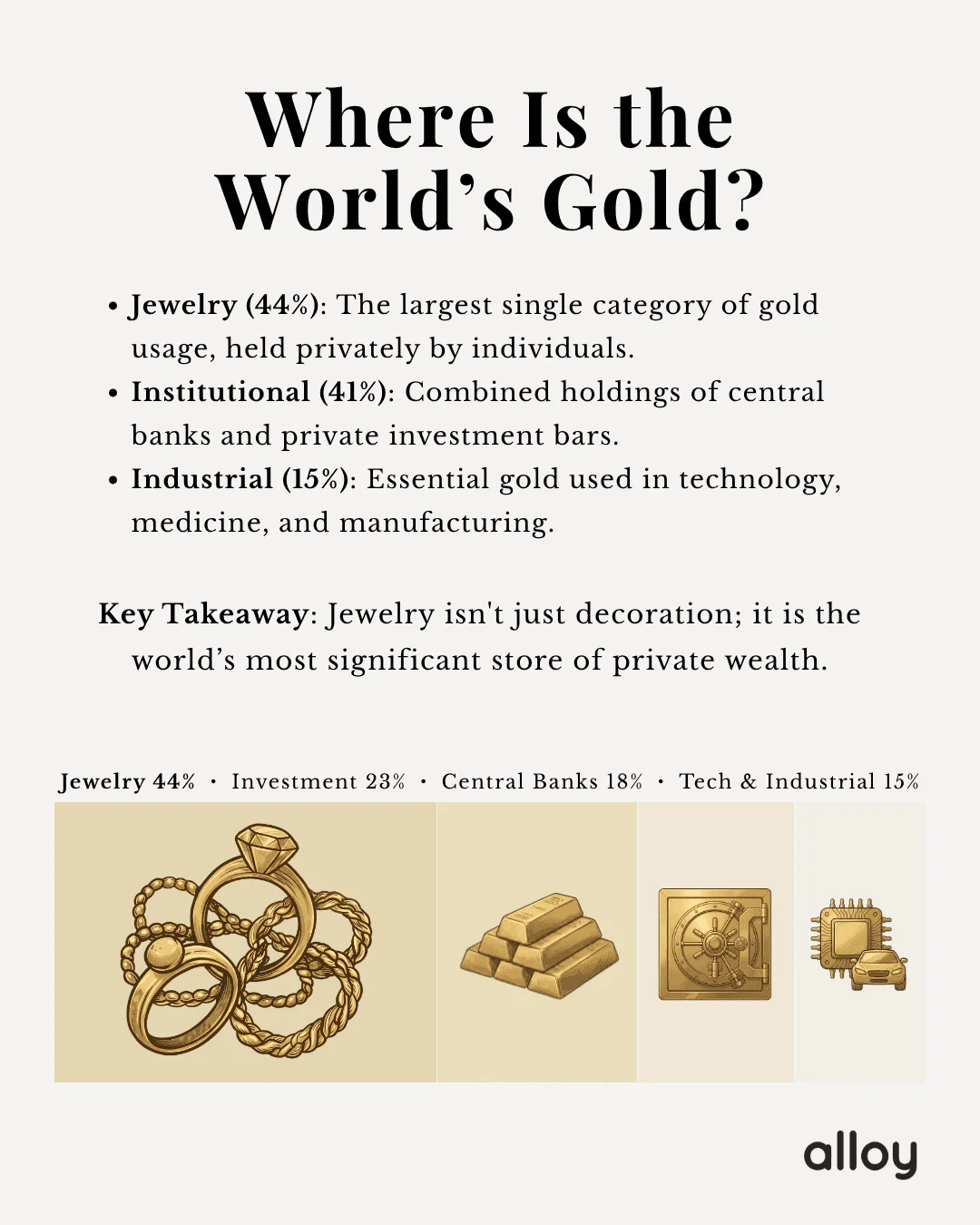
Data from both the World Gold Council (WGC) and the U.S. Geological Survey (USGS) show closely aligned distributions of global gold use. Jewelry represents the largest single category of gold holdings worldwide, surpassing both central bank reserves and investment products such as bars and coins.
Unlike these other forms, which are typically held by institutions or investors, gold jewelry is owned by individuals worldwide. It serves not only as an adornment but also as a store of value, making it one of the most widely distributed forms of wealth.
The breakdown below highlights how global gold supply is allocated across its primary uses:
| Category | Estimated Tonnes | Share of Total | Source Alignment |
|---|---|---|---|
| Jewelry | ~97,600 | ~44% | WGC / USGS (~40%) |
| Investment (Bars & Coins) | ~51,000 | ~23% | WGC / USGS (~24%) |
| Central Banks | ~38,700 | ~18% | WGC / USGS (~21%) |
| Technology & Industrial Use | ~32,600 | ~15% | WGC / USGS (~7% electronics + other) |
| Total Above-Ground Gold | ~220,000 | 100% | WGC |
Why So Much Gold Exists as Jewelry
The reason jewelry dominates global gold holdings comes down to a combination of cultural tradition and financial utility. While high-karat gold is not commonly used in jewelry in the United States, it is widely preferred in other parts of the world. In countries like India, China, and across the Middle East, 22K and 24K gold jewelry is traditionally worn for special occasions. Many cultures gift gold jewelry during weddings, festivals, and births as a symbol of prosperity and good fortune.
Because this jewelry is high in purity and retains intrinsic value, it is often viewed as both an adornment and a financial asset. It can serve as a form of long-term savings or generational wealth. High-karat gold jewelry is also relatively easy to buy and sell, making it a liquid asset that can help hedge against inflation.
In other markets, including the United States and Europe, lower-karat gold such as 10K, 14K, and 18K is more common. While these pieces contain less pure gold, they still contribute significantly to the global gold supply and retain recoverable value based on their metal content.
Its wearability makes gold jewelry more accessible to hold than bars or coins.
Jewelry Isn’t Just Decorative, It’s Financial
Those who own gold jewelry, especially high-karat pieces, hold assets that behave much like money in the real world. While sellers typically do not recapture the retail markup when parting with jewelry, the intrinsic value of the gold remains. It can always be sold for its precious metal content, after which it is typically melted down and refined for reuse.
The value of gold jewelry generally tracks the global spot price, connecting everyday individuals to the broader gold market. Although buyers rarely pay the full melt value for a piece, the market still establishes a consistent benchmark for its worth. Because gold can be reused indefinitely, it regularly flows in and out of the jewelry market. Jewelry is not a static asset; it can be reshaped, resold, and revalued over time.
Jewelry Keeps Gold in Circulation
Did you know?
Gold never dies; it just changes form. That 14K bracelet someone is wearing today could very well contain atoms of gold worn by a Roman merchant 2,000 years ago.
Like all gold products, jewelry enters the market through mining and manufacturing. A portion of newly mined gold, typically around 1,800 to 2,200 tonnes each year, is allocated to jewelry production. From there, gold jewelry moves through a continuous cycle of private ownership, resale, and recycling.
Gold jewelry is part of a global loop. A significant portion of new jewelry is made from recycled gold, much of which originates from previously owned pieces. Each year, roughly 1,300 tonnes or more of gold supply comes from recycling, with jewelry serving as one of its primary sources. Gold does not disappear; it simply changes form. This continuous cycle is what keeps gold supply flowing, even as new mining remains relatively limited.
Recycling activity closely follows gold prices. When prices rise, more people choose to sell old or unused jewelry, increasing the recycled supply. When prices fall, owners are more likely to hold onto their pieces, reducing the amount of gold re-entering the market.
Key Takeaway
Jewelry plays an interesting role in the global distribution of gold. Accounting for nearly half of all the gold ever mined, it is an asset not just stored but worn and continuously circulated as part of an ongoing lifecycle.
Unlike gold held in vaults or financial instruments, jewelry is widely distributed across individuals, cultures, and economies. Its ability to move between ownership, be reshaped, and re-enter the market ensures that gold remains both a personal asset and one of the most widely distributed stores of wealth in the world.
Methodology & Data Sources
This analysis synthesizes the most recent global gold data from the industry’s primary regulatory bodies. All monetary valuations are calculated using the April 13, 2026 spot price of $152.94/gram.
Click to view full Methodology, Data Sources & Technical Notes
The data presented in this article is a synthesis of the most recent annual reports from the gold industry’s primary regulatory and statistical bodies. All monetary valuations are based on the April 13, 2026 gold spot price of $152.94/gram.
- 1. Above-Ground Stocks & Jewelry Share: Total gold tonnage (~220,000t) and jewelry’s allocation (~44% or 97,000t) are sourced from the World Gold Council (WGC) GoldHub (Q1 2026 Update).
→ View WGC Above-Ground Stocks - 2. Global Supply & Recycling: Annual allocation of newly mined gold and jewelry recycling volume (approx. 1,300+ tonnes annually) derived from the U.S. Geological Survey (USGS) 2026 Mineral Commodity Summaries.
→ View USGS Gold Statistics - 3. Market Comparisons: Corporate market capitalizations for NVIDIA, Apple, Microsoft, and Amazon used for the “Melt Value” comparison were verified via live exchange data as of the close of business April 13, 2026.
- 4. Population Data: Per capita distribution figures are based on the United Nations World Population Prospects 2024 (2026 Revision), utilizing a baseline population of 8 billion people.
→ View UN Population Data - 5. Technical Purity Standards: Regional purity benchmarks (14K, 22K, 24K) and financial liquidity factors were cross-referenced with the Bureau of Indian Standards (BIS) and CIBJO (World Jewellery Confederation).
→ View BIS Hallmarking Overview
Disclaimer: All valuations represent intrinsic “melt value” only. Retail prices, which include craftsmanship, branding, and merchant markups, typically range 100% to 800% higher than the raw metal value.
Download Press Assets
Includes high-resolution infographics, charts, and raw data tables (ZIP, 14.2 MB).