
Chinese Silver: Taels, Sycee, and the Pre-Modern Silver Currency System Explained

Money in imperial China worked a bit differently from that in Europe; instead of minted coins, the system relied on Chinese silver bullion. Value wasn’t stamped onto a coin; instead, it was calculated by weight and fineness. The standard measurement used for trade and taxes was the tael (liang), roughly 37 to 40 grams of silver.
Since the government didn’t mint standard currency, silver circulated as sycee, which were just custom ingots poured by private smiths. This meant that everyday business required merchants to weigh and verify the metal on the spot. Even with its decentralized nature, this silver system ran the economy for centuries, operating right alongside everyday copper coins and incoming foreign silver.
Historical Development of Silver in China
Early use of silver in China (Pre-Tang to Tang Dynasty)

China valued silver for a long time before adopting it as legal currency. In the early days, specifically the Zhou, Qin, and Han periods, everyday trade relied on bronze cash or direct bartering.
Because silver was scarce and didn’t come in fixed denominations, it remained outside the standard marketplace for a long time. Instead of functioning as cash, it was mostly reserved for elite wealth storage, government reserves, and high-end luxury items. Wealthy families and the imperial court commissioned silver not as bullion but as intricate personal items: think elaborate hairpins, heavy jewelry, Buddhist religious offerings, and lavish banquet tableware such as plates and wine cups. For centuries, centrally minted bronze coins remained the real backbone of daily transactions, especially under the Han, while silver stayed locked away in elite estates as a status symbol.
That dynamic only really began to change during the Tang Dynasty (618–907 CE). Boom times in domestic and international trade forced a need for higher-value currency. Suddenly, silver was everywhere in large-scale trade, state accounting, and tax payments. Bronze remained dominant for small purchases, but the Tang era effectively marked the transition toward the heavy reliance on silver seen later in the Song, Yuan, Ming, and Qing dynasties.
Rise of silver currency (Song to Ming Dynasty)
By the tail end of the Ming Dynasty, silver had transitioned from a niche tool for wealthy merchants into the absolute backbone of China’s entire economy. A perfect storm of rapid business growth, massive tax overhauls, and a steady influx of foreign bullion pushed silver into everyday society.
The economic groundwork laid down across the Song, Yuan, and Ming eras essentially locked in China’s monetary habits for generations, directly paving the way for the deeply entrenched silver economy of the subsequent Qing Dynasty.
Late Imperial System (Qing Dynasty)

By the 1800s, the Qing Dynasty had perfected a remarkably advanced bullion-based monetary system. Silver did all the heavy lifting for state finances, large-scale wholesale trade, and tax collecting, leaving cheap copper coins to handle small daily errands in the marketplace. The whole operation lacked a centralized, uniform standard, but it worked surprisingly well anyway.
By blending regional tael weights, private sycee, and a steady stream of foreign silver, the empire fueled commerce across vast distances. In reality, this mature silver network was the peak of China’s traditional monetary evolution; a bridge that sustained the imperial economy for centuries before modern banking systems took over in the twentieth century.
The Tael System

At the absolute center of China’s historical silver economy was the tael (liang). While it is easy to think of it simply as a unit of weight, it actually served a dual role as a universal unit of account for state taxes, commercial contracts, and imperial finances.
Unlike modern money, a tael wasn’t a physical coin or a stamped denomination. It was just a specific amount of raw silver, meaning its actual purchasing power depended on its exact weight and purity at the time of purchase. Because of this open-ended setup, everyday transactions usually involved extensive weighing, testing, and manual verification before any deal was closed.
For bookkeeping purposes, the tael was broken down into smaller decimal increments:
- Mace: Equal to one-tenth (1/10) of a tael.
- Candareen: Measured at one-hundredth (1/100) of a tael.
- Li: The smallest tier, calculated at one-thousandth (1/1000) of a tael.
What really made the Chinese silver system unique, and sometimes incredibly frustrating for outsiders, was that there was no single, nationwide standard for the tael. Different provinces, government branches, and trade guilds invented their own specific metrics. A few of the most influential standards included:
| Tael Standard | Estimated Weight | Main Real-World Use |
|---|---|---|
| Kuping | ~37.3 grams | The official government standard used for collecting state taxes. |
| Customs (Haikwan) | ~37.8 grams | The baseline used exclusively for foreign maritime trade and duties. |
| Shanghai | ~33.9 grams (fine silver) | The commercial anchor for major banking and merchant guilds. |
| Caoping | ~36.7 grams | A heavily utilized standard for local and regional marketplace trade. |
~37.3 grams
The official government standard used for collecting state taxes.
~37.8 grams
The baseline used exclusively for foreign maritime trade and duties.
~33.9 grams (fine silver)
The commercial anchor for major banking and merchant guilds.
~36.7 grams
A heavily utilized standard for local and regional marketplace trade.
Even with all these overlapping regional variations, the tael served as the common currency across the empire, holding together China’s unique economy for hundreds of years.
Sycee (Silver Ingots)
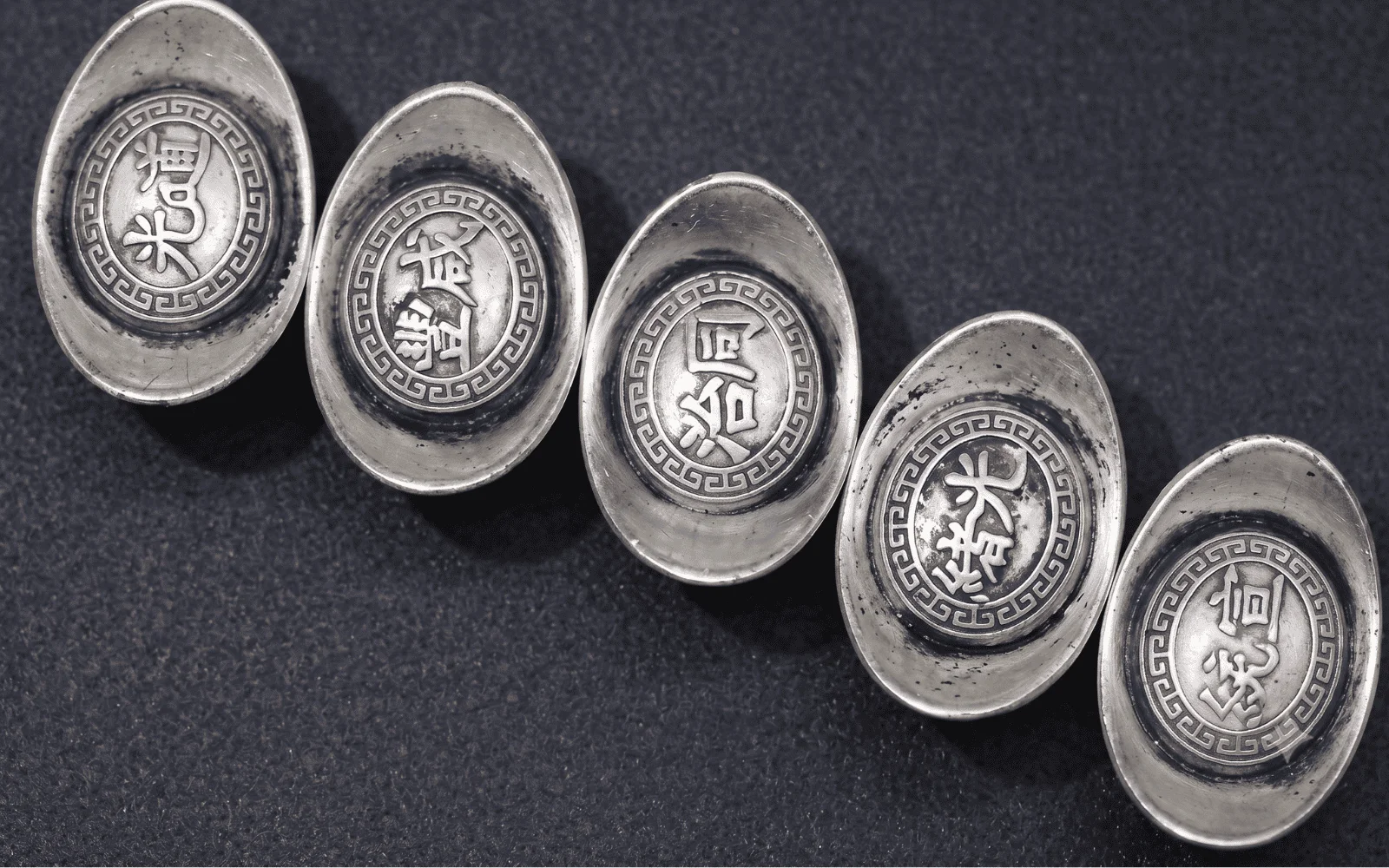
Before standardized coins became the norm, China’s silver moved through the economy as sycee, privately cast silver ingots that handled everything from major merchant trade and local taxes to personal wealth storage. They didn’t have a fixed face value stamped on them by a central government. Instead, a sycee’s value was determined strictly by its weight and metal purity, making it the literal raw material of a bullion-based economy.
Local assayers and private silversmiths poured these ingots rather than an imperial state mint. Because of this decentralized production, sycee came in an odd variety of shapes and sizes. One could find saddle-shaped or oval variations in different regions, though the classic boat-shaped design is what most people recognize today.
Because sycees weren’t uniform, someone couldn’t just hand one over for a quick purchase. Every single transaction required a bit of work: merchants had to break out scales, consult local weight standards, and rely on trusted experts to verify the metal’s true value on the spot.
The physical weight of the ingot naturally dictated how it was used in daily commerce:
| Tael Amount | Approximate Weight | Typical Historical Use |
|---|---|---|
| 1 Tael | ~37 g | Small transactions |
| 5 Taels | ~185 g | Regional commerce |
| 10 Taels | ~370 g | Wholesale trade |
| 50 Taels | ~1.85 kg | Banking and government finance |
~37 g
Small transactions
~185 g
Regional commerce
~370 g
Wholesale trade
~1.85 kg
Banking and government finance
This weight-centric system highlights the core mechanic of China’s Ming and Qing monetary history. Value was tied directly to the physical quality of the silver itself, not to an arbitrary denomination printed on a coin. This practical, decentralized structure successfully anchored the imperial economy for generations before modern banking and paper reforms phased it out in the early twentieth century.
Lack of Standardization

Modern economies rely on a single, uniform national currency, but Chinese silver operated on a completely different logic. Throughout imperial history, silver was treated as raw bullion rather than pre-measured coins. This meant its actual purchasing power came down to three highly variable factors: the physical weight, the purity of the metal, and whatever the local marketplace rules dictated at that exact moment.
Traveling merchants constantly ran into these friction points when doing business across different provinces. A trader moving between commercial hubs might encounter half a dozen different tael weight metrics and fluctuating local exchange rates. Because of this, business couldn’t happen fast; every deal required breaking out the scales, testing the metal’s fineness, and verifying the numbers before any goods changed hands.
This decentralized mess wasn’t an accident; it developed naturally over centuries as regional economies grew up independently of one another. Instead of a central government mint stepping in to guarantee what a piece of money was worth, the entire system relied on a network of private checks and balances:
| Factor | Impact on the Silver Economy |
|---|---|
| Regional tael standards | Different weights used across China |
| Private sycee production | Ingots varied in size and form |
| Purity differences | Silver required testing before acceptance |
| Local commercial customs | Exchange rates could vary by region |
Different weights used across China
Ingots varied in size and form
Silver required testing before acceptance
Exchange rates could vary by region
While this complete lack of uniformity sounds like a recipe for economic gridlock, the system was actually incredibly resilient. For hundreds of years, Chinese merchants, local bankers, and imperial tax collectors successfully managed one of the largest economies on earth. They didn’t need a single national currency standard; they just needed a reliable, shared set of marketplace habits.
Interaction with Global Silver Trade

By the sixteenth century, an explosion in domestic business and massive imperial tax reforms tied China’s economy directly to global trade routes. The empire developed an insatiable hunger for precious metals, quickly becoming the ultimate destination for the world’s silver supply.
Most of this bullion originated in Spanish-controlled colonial mines in Mexico and Peru. It traveled across the Pacific aboard Spanish galleons to Manila, where merchants bartered the raw metal for premium Chinese exports such as silk, high-grade porcelain, and tea.
Consequently, foreign coins like Spanish trade dollars and Mexican pesos became everyday sights along the Chinese coast. However, local merchants completely ignored the official denominations or royal faces stamped on these incoming coins, treating them strictly as raw bullion valued by weight and purity. To verify that a coin wasn’t a cheap copper counterfeit, local bankers and moneychangers would punch unique iron stamps—known as “chopmarks“—directly into the silver.
Over time, heavy circulation would leave these coins completely covered in a chaotic mosaic of merchant stamps. This historic reliance on foreign imports evolved through distinct eras:
- Song & Yuan Dynasties: Trade relied heavily on domestic mining and overland Eurasian routes, keeping silver as a luxury asset rather than standard marketplace cash.
- Ming Dynasty: The arrival of Spanish-American silver via Manila flooded the economy, forcing the imperial state to formalize silver as its primary fiscal standard.
- Qing Dynasty: Highly trusted Mexican pesos and international trade dollars effectively ran coastal commercial hubs, anchoring the price index for regional markets.
This massive influx of global silver did more than just lubricate daily transactions; it bound China’s economic health to international mining and trading networks. By the nineteenth century, shifting bullion outputs in the Americas could trigger sudden, painful price shocks inside remote Chinese villages, offering an early preview of our interconnected global economy.
Decline of the Silver System
By the late 1800s, China’s traditional silver setup couldn’t keep up with the pressures of global modernization. The old ways of doing business, relying on fluctuating regional taels and clunky, custom-made sycee bricks, became a major headache in a world moving toward fast, automated finance.
The system faced multi-front friction: highly uniform Mexican pesos and Western trade dollars flooded the coastal markets, offering an easy alternative to manual weighing. Meanwhile, modern banks and paper banknotes began to appear, chipping away at the need for heavy bullion transactions entirely.
When the Qing Dynasty collapsed in 1912, the new republic immediately targeted the old financial chaos. Reformers wanted a single, standardized national currency that was easy for a central government to regulate and track.
This multi-decade collapse essentially boiled down to four overlapping pressures:
- The Tael Fragmentation: Keeping track of countless regional tael standards made interstate commerce and modern corporate accounting incredibly difficult.
- Foreign Infiltration: Highly trusted international trade dollars provided direct, stiff competition to traditional Chinese silver casting.
- The Rise of Paper: The growth of modern, corporate banking houses rapidly reduced society’s daily reliance on raw bullion deals.
- The Standard Push: Early-twentieth-century state reforms actively encouraged uniform, minted-coin alternatives.
The definitive end of the old era came in 1933, when the Chinese government officially abolished the tael as a legal unit of account. While physical silver still circulated in parts of the country for a bit longer, this sweeping decree effectively killed off the ancient, weight-based system that had run imperial trade, taxes, and state finance for hundreds of years.
Legacy of the Silver Era
Even though China’s weight-based silver economy dissolved during the twentieth century, its impact remains heavily visible across economic history and numismatics. Surviving sycee, chopped trade dollars, and rough silver ingots have become highly prized museum exhibits and collector assets, offering physical proof of how this distinctive marketplace operated.
For economic historians, the tael (liang) stays relevant as a crucial unit for decoding old imperial tax ledgers and tracking the global shipping networks of the Ming and Qing eras. The entire system stands out as a fascinating historical anomaly: an economy of massive scale that didn’t rely on state-minted coins, but instead ran entirely on raw bullion mass, independent metal assaying, and basic commercial trust.
Ultimately, silver served as the infrastructure underpinning imperial China’s massive public finances and merchant trade. From its gradual adoption under the Song to its peak under the Qing Dynasty, this metal determined how wealth was calculated across a vast empire. By building an economy around decentralized weights and custom-cast ingots, China operated a highly sophisticated bullion system that differed markedly from the uniform, state-stamped coin models used in Europe.
Even though twentieth-century banking reforms eventually phased out raw metal in favor of paper banknotes and standardized coins, the historical Chinese silver market left a permanent mark on the global trade routes that permanently linked the economies of Asia, Europe, and the Americas.


