
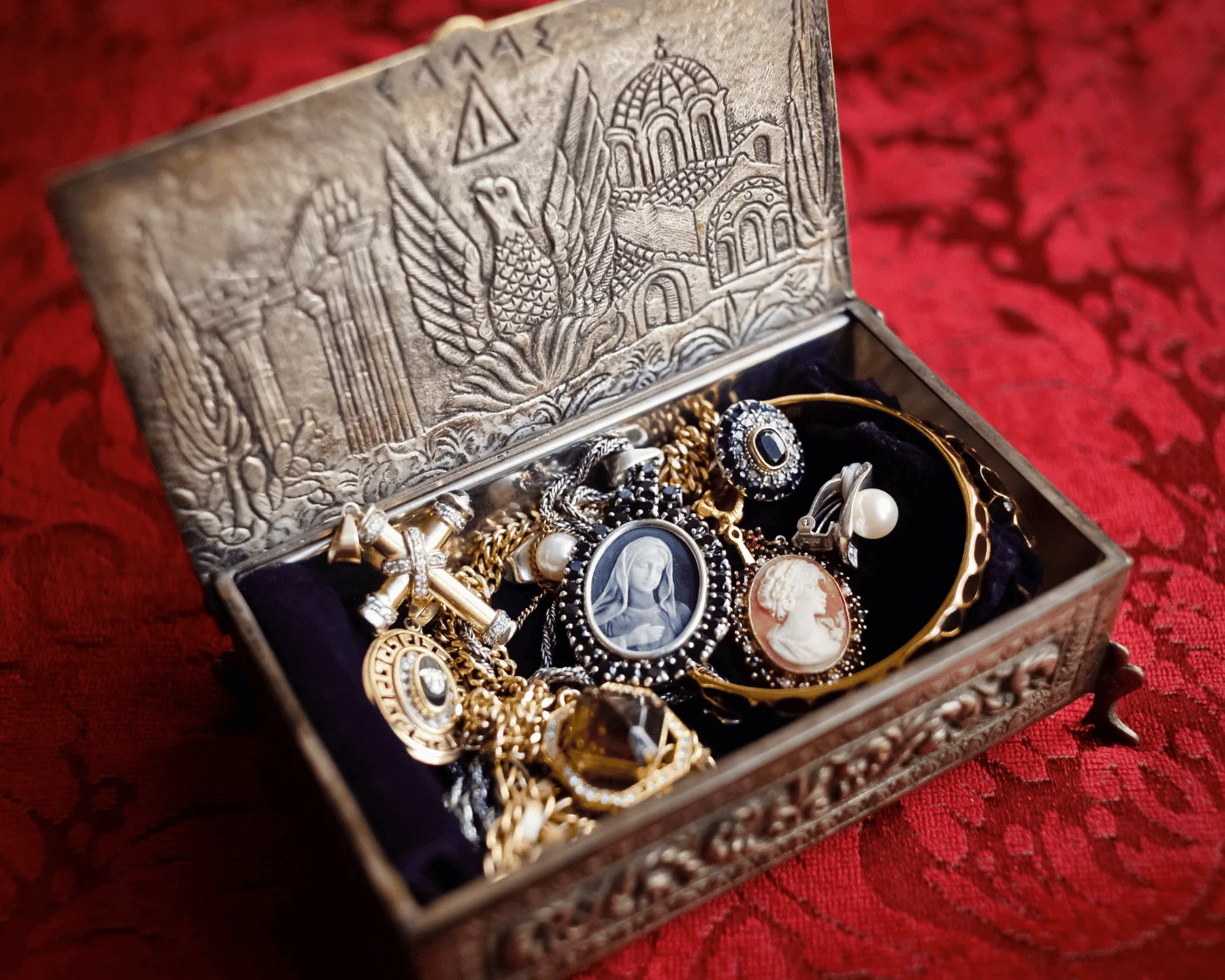
Sell Estate Jewelry: Where to Sell & How to Estimate Value


Estate jewelry comes into people’s possession in many ways, from inherited antique and vintage pieces to secondhand purchases at a fraction of their original price. But just as easily, it can change hands again, often through a sale to raise cash, and that requires understanding what a piece is worth before accepting an offer.
This guide covers everything someone needs to know about selling estate jewelry, including how to estimate its value and the best places to sell.
In a nutshell
Estate jewelry is any piece of jewelry that has been previously owned, whether it’s an inherited heirloom, a vintage collectible, or a recently purchased ring. Before selling, it’s important to understand what determines its value, including precious metal content and gemstones, designer brands, provenance, and condition.
This guide explains how to estimate the value of your estate jewelry, compares the best places to sell it, and highlights common mistakes to avoid, so you can make an informed decision and maximize your payout.
What Is Estate Jewelry?

Estate jewelry refers to any piece of jewelry that has been previously owned, regardless of its age, style, or origin. It can include everything from antique jewelry to more recent pieces that have simply changed hands.
That may come as a surprise to many, given the popular assumption that estate jewelry refers only to pieces that are extremely old, rare, or associated with a wealthy estate. The fact is that the term has less to do with prestige or age and more to do with ownership history. All pieces that have had a previous owner technically fall under the category of estate jewelry.
What counts as estate jewelry?
Based on that definition, estate jewelry includes:
- Inherited pieces passed down after a family member’s passing.
- Heirloom items that have been kept within a family for generations.
- Antique jewelry is often defined as pieces that are at least 100 years old.
- Vintage jewelry (pieces that are between 20 and 99 years old)
- Pre-owned items, including gold rings, wedding bands, necklaces, and other modern jewelry that have been resold or traded
Estate jewelry vs vintage jewelry vs antique jewelry
The easiest way to understand these terms is that estate jewelry refers to ownership, while vintage and antique refer to age. A single piece of jewelry can fit into more than one category.
- Estate Jewelry: Any piece of jewelry that has had a previous owner, regardless of its age. This can include a ring purchased just a few years ago or a century-old heirloom.
- Vintage Jewelry: Jewelry that is generally 20 to 99 years old. A vintage piece may also be estate jewelry if it has been previously owned, which is the case for most vintage jewelry on the market.
- Antique Jewelry: Jewelry that is 100 years old or older. Antique jewelry is almost always estate jewelry because it has passed through one or more previous owners over its lifetime.
For example:
- A 1920s Art Deco ring is considered estate, vintage, or antique jewelry, since it has had previous owners and is more than 100 years old.
- A five-year-old diamond engagement ring that has been resold is estate jewelry, but it is not vintage or antique.
- A 1970s gold bracelet is both estate and vintage jewelry, but not antique.
Is Estate Jewelry Worth Anything?
Estate jewelry is valuable and can be worth anything from a few dollars to thousands of dollars. Below are the factors that can affect its value.
Precious metal content
The biggest factor affecting the value of estate jewelry is its precious metal content, also known as its intrinsic value. It refers to the value of the raw material contained within the piece.
Two things determine that intrinsic value: purity and weight.
Purity refers to how much of the precious metal the item contains. For gold jewelry specifically, it is measured in karats, wherein a 24-karat piece is considered pure gold while lower karat ratings contain a greater percentage of other metals.
Silver and platinum, on the other hand, are measured using fineness markings, such as 925 silver or 950 platinum.
As for weight, a heavier piece contains more precious metal and thus possesses a higher intrinsic value than the lighter one (provided both pieces have the same purity level).
The value of those metals is tied to their current market price, commonly referred to as the spot price. As gold, silver, and platinum prices rise or fall, the intrinsic value of estate jewelry moves with them.
Many estate jewelry buyers start by examining an item’s precious metal content first, as this provides the most objective measure of value before considering any other characteristics that may add value.
Gemstones and diamonds
Gemstones and diamonds are evaluated separately from the precious metal content of an estate jewelry piece. In some cases, they can be worth more than the gold, silver, or platinum setting itself, thereby substantially increasing the item’s overall value.
Diamonds are typically evaluated using the Four Cs: carat, cut, color, and clarity. Generally speaking, larger diamonds with stronger grades in these areas command higher prices.
Other gemstones, such as sapphires, rubies, and emeralds, are evaluated based on factors such as size, color, clarity, rarity, and overall quality.
Whether a stone is natural or lab-grown can also affect value. Natural diamonds and gemstones generally command higher resale prices because they are rarer, whereas lab-grown stones are more abundant and often sell for less on the secondary market.
Maker’s marks and luxury brands

Many jewelry manufacturers leave identifying stamps, signatures, or hallmarks on their pieces, commonly referred to as maker’s marks. These markings can help verify who created the piece and, in some instances, when and where it was made.
Estate jewelry from renowned brands like Cartier, Tiffany & Co., Van Cleef & Arpels, and Harry Winston can often sell for substantially more than their unsigned counterparts.
Story and provenance
Much like artwork, part of an estate jewelry piece’s appeal can come from the story behind it. It often comes as a surprise to many first-time sellers just how much collectors and estate jewelry buyers care about a piece’s history.
That documented history is known as provenance, which consists of records that help prove a piece’s origin, ownership history, and authenticity. This can include:
- original sales receipts
- previous appraisals
- certificates of authenticity
- documentation linking the jewelry to a notable person.
A strong provenance can increase both buyer confidence and the value of the estate jewelry.
Rarity and historical interest
Estate jewelry pieces associated with a particular historical period or that possess craftsmanship that is no longer produced today are often highly sought after. The rarer a piece is and the fewer comparable examples that exist, the greater its potential appeal to collectors and buyers.
Craftsmanship and condition
Features such as intricate metalwork, hand engraving, detailed filigree, and other displays of skilled craftsmanship can make a piece more desirable than a mass-produced equivalent.
Condition is just as important. Well-preserved pieces often fetch higher offers than items with excessive wear, missing stones, or damaged settings.
Where to Sell Estate Jewelry
Sellers have several options for selling antique, vintage, inherited, or other estate jewelry. Factors such as the type of jewelry, how quickly it needs to be sold, and the balance between convenience and maximum payout all influence the best route for selling.
| Where to Sell | Best For | Pros | Cons |
|---|---|---|---|
| The Alloy Market | Sellers looking for a secure and convenient way to sell estate jewelry online. |
|
|
| Jewelry Consignment Stores | Sellers who are not in a rush and want the possibility of a higher selling price. |
|
|
| Auction Houses | Sellers with rare, historically significant, or high-value estate jewelry. |
|
|
| Local Jewelers and Estate Jewelry Specialists | Sellers who prefer face-to-face evaluations and direct offers. |
|
|
| Pawn Shops | Sellers who need immediate cash. |
|
|
| Online Marketplaces (eBay, Etsy, etc.) | Sellers who want greater control over pricing. |
|
|
Sellers looking for a secure and convenient way to sell estate jewelry online.
- Free, insured shipping
- Fast, same-day payment
- Additional 25% bonus from resale profit for qualifying pieces (Double Pay)
- No need to create listings or market the item
- Offers are based solely on the metal value.
Sellers who are not in a rush and want the possibility of a higher selling price.
- Potential for higher selling prices
- Ownership remains with the seller until sale
- Access to the store’s customer base
- The item may take weeks or months to sell
- Commission fees reduce final payout
Sellers with rare, historically significant, or high-value estate jewelry.
- Bidding may push the final selling price above initial estimates
- Professional authentication and marketing
- Seller commissions can be substantial
- Sales are tied to auction schedules
Sellers who prefer face-to-face evaluations and direct offers.
- Fast sale process
- No shipping fees
- Opportunity to negotiate prices
- Local buyer competition may be limited
- Multiple consultations may be needed to compare offers
Sellers who need immediate cash.
- Instant cash on the spot
- No appointment needed
- Minimal paperwork
- Often offers the lowest payouts among estate jewelry buyers
Sellers who want greater control over pricing.
- Create your own listings and set prices
- Large pool of potential buyers
- Suitable for niche and collectible pieces
- Platform fees can be high
- Greater risk of disputes, returns, and fraudulent buyers
- Items may take time to sell
How to Estimate the Worth of Estate Jewelry
Sellers should have a rough idea of the value of their estate jewelry before approaching any buyer. While no estimate can guarantee the final selling price, having a baseline value makes it easier to compare offers, set realistic expectations, and avoid leaving money on the table.
Some practical ways to estimate the value of estate jewelry include:
Calculate intrinsic value

For pieces made primarily from gold, silver, or platinum, a basic estimate can be calculated using the formula:
metal purity x weight x current spot price
The simplest way is to use an online calculator such as the one here:
The purity can often be identified through stamps such as 14K, 18K, 925, or 950, while the weight can be obtained using a kitchen scale (grams). As for spot prices, one can easily check them through a quick Google search.
Estate Jewelry Calculator
Keep in mind that this only estimates the raw material value (scrap value) and does not account for gemstones, designer premiums, rarity, or provenance.
Additionally, actual offers tend to be lower than the calculated amount because buyers must account for refining, resale, and operating costs.
Get a professional appraisal

An experienced appraiser, estate jeweler, or gemologist can provide a more informed estimate of a piece’s value. Before the appointment, gather any supporting documents such as original receipts, certificates of authenticity, previous appraisals, and provenance records.
Research comparable sales online
Visit online auction sites, jewelry marketplaces, and estate jewelry listings and use the site’s pricing as benchmarks. It is better to look at completed or sold listings rather than asking prices since the latter do not necessarily reflect what buyers are willing to pay.
Avoid These Common Mistakes When Selling Estate Jewelry
Getting the most money out of the sale is not always about chasing the highest-paying buyer. In many cases, it boils down to avoiding the common mistakes that unnecessarily reduce a piece’s value or lead to seller’s remorse.
Not asking about fees and commissions upfront
Does the sale involve commissions, listing fees, or shipping charges? Before committing to a sale, know exactly what fees apply, how they are calculated, and how they affect the final payout. Set expectations early and avoid disappointments later.
The Alloy Market does not charge any fees; sellers keep 100% of the quoted offer price.
Assuming every piece is only worth scrap value

Some estate jewelry pieces are worth substantially more than their scrap value due to factors such as rarity, provenance, maker’s marks, historical significance, and gemstone value. All of these can add value beyond the underlying gold, silver, or platinum content.
Selling jewelry without cleaning it first
Estate jewelry covered in dust, fingerprints, or years of buildup may appear less desirable than it actually is. As the saying goes, first impressions last. Warm water, mild soap, and a soft cloth are often all that’s needed to keep it clean and presentable. This can help bring out the details such as gemstones, hallmarks, maker’s marks, and fine craftsmanship that might otherwise be overlooked.
When selling estate jewelry to The Alloy Market, the condition does not matter. Instead, offers are based on the metal value alone, regardless of whether the piece is broken, damaged, missing stones, etc. There is no need to polish up items before sending them in for evaluation.
If a piece is determined to have resale value, Alloy will professionally clean it, photograph it, and list it on the marketplace. If that piece sells, the seller automatically receives a second payout for 25% of the profit. They get to enjoy the benefits of the marketplace without any of the work!
Selling while still grieving
Many estate jewelry pieces come from recent inheritances following the loss of a loved one. Unless there’s an urgent financial need, one should take time to evaluate the piece and reflect on what it means to them personally. Otherwise, selling it during such an emotional period can lead to seller’s remorse.
Throwing away boxes, receipts, and certificates
Original boxes, receipts, certificates of authenticity, previous appraisals, and other documentation can help establish provenance and support a higher valuation. Once these records are discarded, replacing them can be difficult and, in some cases, impossible.
There is no need to send in any boxes, receipts, or certificates when selling to Alloy as offers are based on the metal value alone.
Sell Estate Jewelry With Confidence and Competitive Payouts

The Alloy Market specializes in buying precious metal items, including many forms of estate jewelry. Sellers can request a free, insured Alloy Evaluation Kit, ship their items via insured, trackable shipping, and receive a competitive offer after evaluation.
For eligible items, sellers may also receive an additional 25% bonus on resale profit if the item is later sold through Alloy’s marketplace under our Double Pay program. Get paid more without doing any extra work!
Items are evaluated for purity and weight upon receipt, and we’ll send you a detailed, itemized purchase offer. When you accept, we initiate payment that day. If it doesn’t work out, we’ll ship your items back at no cost.
Join the thousands of happy customers who have made Alloy their go-to precious metal dealer.


