
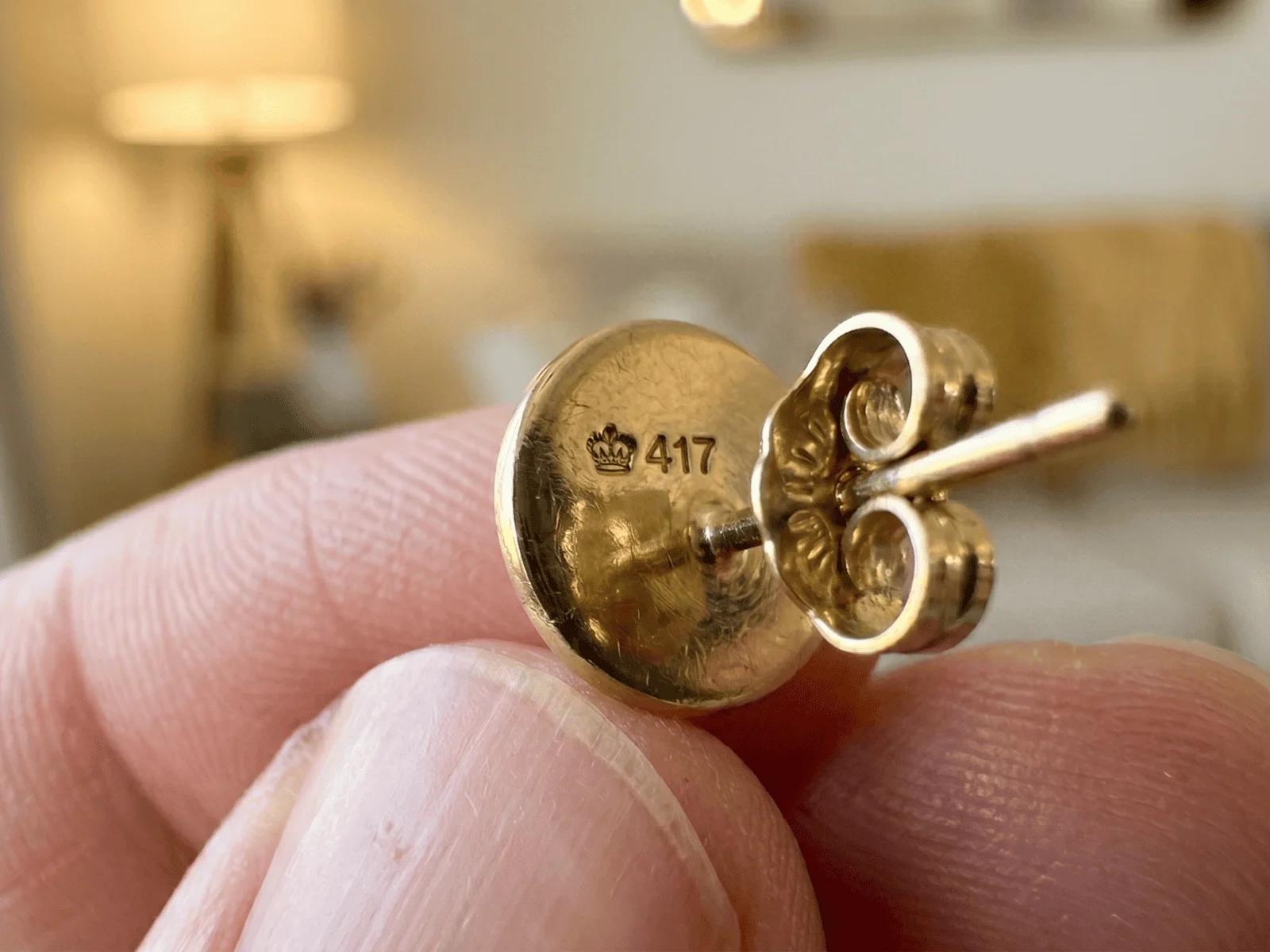
What Does a 417 Gold Stamp Mean?


The small 417 gold stamp on a piece of jewelry is one of the easiest ways to determine its purity.
In a nutshell
A 417 stamp on gold jewelry indicates the piece is 10K gold, containing 41.7% pure gold and 58.3% alloy. It uses the millesimal fineness system, which measures gold purity in parts per thousand instead of karats. While functionally the same as a 10K mark, 417 is more commonly used internationally and is often found on durable, everyday jewelry like rings, chains, and bracelets. 417 jewelry has resale potential because it is 41.7% pure gold.
Why 417 Gold Stamp Instead of 10K?

What is the difference between a 10K vs. 417 stamp? It’s pretty much the same thing.
CIBJO (the World Jewellery Confederation) explains that gold may be described either by caratage (as the US knows it, “karatage”/karats) or by fineness.
The 1972 Hallmarking Convention, also known as the Vienna Convention, established this system for testing and marking precious metals, which is recognized worldwide. This means that certified pieces can move between member countries without needing to be marked again.
| Stamp | System | Meaning | Fine Gold Content |
|---|---|---|---|
| 10K | Karat system | 10 parts gold out of 24 | 41.7% |
| 417 | Millesimal fineness | 417 parts gold out of 1,000 | 41.7% |
| 14K | Karat system | 14 parts gold out of 24 | 58.3% |
| 585 | Millesimal fineness | 585 parts gold out of 1,000 | 58.5% |
| 18K | Karat system | 18 parts gold out of 24 | 75.0% |
| 750 | Millesimal fineness | 750 parts gold out of 1,000 | 75.0% |
Common Places to See the 417 Stamp
Everyday rings, chains, and bracelets sold at mall jewelry stores and local shops are the most common places to find a 417 stamp. The same applies to men’s jewelry, such as signet rings, Franco chains, Cuban links, and wider bracelets.
The gold content is not intentionally low to mislead customers. Alloying (mixing metals) provides softer pure gold with durability, and 10K’s higher alloy content makes it a better choice for affordable fine jewelry intended for everyday use.
While 14K holds the top spot as the most common alloy in the American market overall, 10K maintains a significant position in the value-oriented segment.
The 417 stamp is also common on class rings. Major class ring manufacturers continue to use 10K as a standard material, as these rings are often thick, detailed, and intended to last for decades.
Where is the Stamp and What Does It Look Like?
For rings, the stamp is typically on the inside of the shank (the band that sits against the finger). On chains and bracelets, it is usually on the clasp or tag; on pendants, it is generally on the bail (the small loop through which the chain passes).
Sometimes a 417 stamp is accompanied by a “10K” mark, depending on the manufacturer and the market for which the jewelry was produced. A combination of the fineness mark and a country-of-manufacture notation may also appear, such as “417 Italy.” Occasionally, the fineness mark appears beside a manufacturer’s cartouche or maker’s mark, enclosed in a small geometric shape.
Is the 417 Stamp Ever Fake?
A stamp, whether struck, engraved, or laser-marked, is a representation of the metal content. But it’s not a guarantee that that’s what one is getting.
Several methods can be used to verify the authenticity of the gold content. If the “gold” layer wears off, revealing a copper- or silver-colored metal underneath, the piece is likely gold-plated rather than solid gold. Plated jewelry is typically labeled as gold-filled or gold electroplated rather than solid gold.
Additionally, if a piece appears silver but bears a 417 stamp, it is not sterling silver. Silver purity marks are 800, 900, or 925. A white piece marked 417 is almost certainly 10K white gold, made by alloying gold with white metals and often rhodium-plated to brighten the surface.
Why 417 Gold Is Used
Pure gold, at 24 karats, is extremely soft. This softness is why gold is never used to make durable tools like a pickaxe or a shovel.
Alloying gold with other metals addresses this softness, making it harder and less prone to scratching and bending. For this reason, lower-karat alloys are prominent in everyday jewelry. 417 gold is specifically 41.7% gold and 58.3% alloying metals.
Identifying Other Common Stamps You Might See
Examining a jewelry box or an inherited collection will likely reveal more than one kind of stamp. These are some of the most common marks.
| Stamp | Metal | Purity |
|---|---|---|
| 375 | Gold (9K) | 37.5% |
| 417 | Gold (10K) | 41.7% |
| 585 | Gold (14K) | 58.5% |
| 925 | Sterling Silver | 92.5% |
| 950 | Platinum | 95.0% |
Is 417 Gold Worth Anything?
Is 417 gold real? Is it worth anything? The answer to both is yes.
10K Gold Calculator
For example, with gold at $ 128.45 per gram, a gram of 417 gold contains approximately in gold content before any dealer margin or refining deduction.
Should You Sell 417 Jewelry?
Broken chains, single earrings, and pieces that have not been worn for years can still hold significant value. Gold remains valuable even if a clasp is broken. Additionally, “old” or “damaged” does not always mean scrap. Pieces with gemstones, recognizable maker’s marks, or collectible designs may be worth more than their melt value.
For pieces with resale potential, Alloy’s Double Pay program allows sellers to capture a portion of the upside, offering an additional 10% of the resale profit, or 25% as an Alloy Insider, if their item resells.
When selling, it is important to work with a reputable buyer who tests gold using standard methods (touchstone, XRF, or fire assay), explains the results, and bases offers on verified purity and weight. A clear breakdown of the piece, including weight, fineness, market price, and deductions, should be provided.
Sell Your 417 Gold with The Alloy Market

Have you got 417 gold to sell? Alloy makes it easy to do so from the comfort of your home. Simply request a free Evaluation Kit to get started. We’ll ship it right to your door and include a postage-paid parcel to pack your items. Drop them off at the nearest FedEx location or request an at-home pickup to send them to us for a purchase evaluation.
If you live in the Newtown area, we offer on-location evaluations when you request an appointment. If you have questions before sending in your items, you may call to speak with an Alloy Advisor who is happy to help.
Once your items are evaluated for purity and weight, we will send you a detailed, itemized purchase offer. When you accept, we initiate payment the same day. If you decline, we’ll send your items back at no additional cost.
If your item qualifies for resale, you may participate in our Double Pay program without any additional work on your part. We’ll list your item for sale on our marketplace, and if it resells, we’ll automatically send you an additional 10% of the resale profit, or 25% as an Alloy Insider. You capture some of the upside of the Marketplace without any of the hassle of managing a listing.
Get started today and join the thousands of happy customers who have made Alloy their go-to precious metal dealer.


