
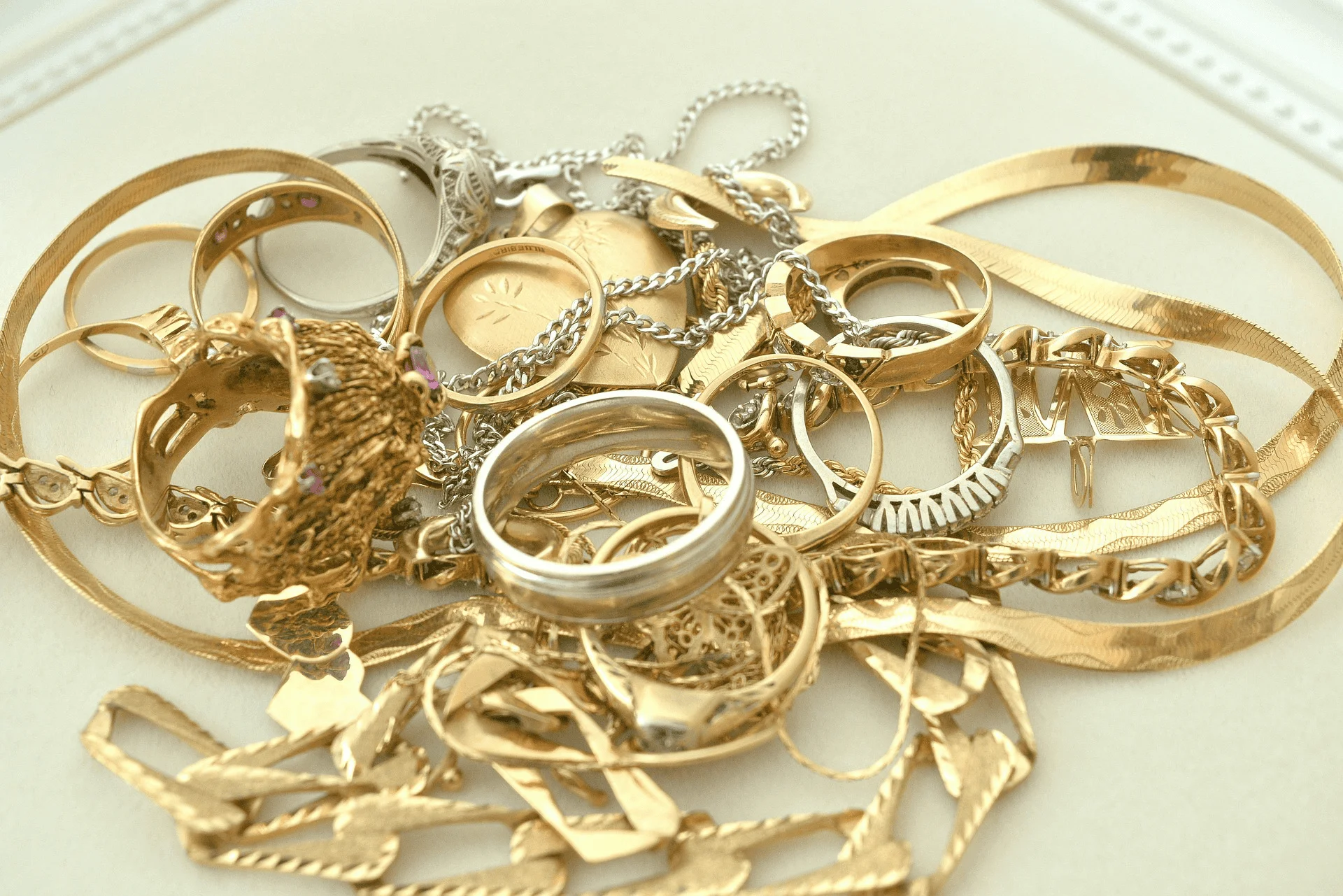
Best Way to Sell Gold Jewelry for Maximum Cash


There are many reasons you may want or need to sell your gold jewelry, such as a breakup, an inheritance, or just needing cash. Whatever the case may be, trying to get the most money for your items may feel daunting, especially if you’ve never sold gold before. Many first-time sellers walk in completely blind as to what their gold is worth.
At The Alloy Market, we believe transparency starts before you ever ship a package or step into our office. Below, we break down how to accurately value your gold, spot a lowball offer, and confidently navigate the sale.
What Impacts the Price of Gold Jewelry

Before you ever accept an offer, you should first know how gold buyers calculate them. A trustworthy buyer evaluates gold using four core metrics:
- Karat purity: Pure gold is 24K, but it’s more common for jewelry to combine gold with other metals for strength. For instance, 18K gold is 75% pure gold, but 14K is 58.3% pure gold (often marked 585). The higher the purity, the higher the price per gram you’ll receive when selling it.
- Weight: Gold is sold strictly by its mass, usually measured in grams or troy ounces. Reputable buyers will use state-certified, highly calibrated scales to weigh your item. Even the slightest variance can mean money left on the table, especially when gold prices are high, so it’s important your chosen gold buyer use top-of-the-line equipment.
- The Live Spot Price: This is the live-market value of gold on the global market. This price fluctuates throughout the day, and different gold buyers have different thresholds for the variability of their offers. Some may select one static price for the day, while others may use the variable price at that moment. Be sure you understand each buyer’s policy before accepting their offer.
- Resale Potential vs. Melt Value: If your pieces are broken, damaged, or a design that doesn’t have much demand, it’s likely your item will be sold for its melt value. This takes into account only the raw gold content of your items. However, jewelry still in good condition from luxury houses like Tiffany & Co. or Cartier often carries premium designer value beyond its metal weight.
Capturing secondary market upside: The Double Pay Program
Most gold buyers evaluate everything strictly by its melt value, and that’s exactly what they do with it: melt it. If you sell us an item in resale-ready condition, it may be hand-selected for our marketplace.
- Upfront Payout: You receive your competitive, live-market offer based on standard melt value right away.
- The 25% Double Pay Bonus: If your item sells on the marketplace, we automatically send you a bonus payout equal to 25% of the profit.
It’s the only program in the industry that lets you cash out immediately while still capturing resale upside, with zero listing hassle on your end.

Sell Once. Earn Twice.
Why settle for one payout? Alloy Market’s exclusive Double Pay program lets you participate in the resale upside.
Step 1: Get paid an industry-leading offer upfront.
Step 2: We list your qualifying jewelry on our marketplace.
Step 3: You get a second payment for 25% of the resale profit.
Sell Once. Earn Twice.
Why settle for one payout? Alloy Market’s exclusive Double Pay program lets you participate in the resale upside.
Step 1: Get paid an industry-leading offer upfront.
Step 2: We list your qualifying jewelry on our marketplace.
Step 3: You get a second payment for 25% of the resale profit.
Best Ways to Sell Gold Jewelry Today
The Alloy Market

Traditional scrap buyers profit from keeping people in the dark. At The Alloy Market, we use live spot tracking and precision digital appraisals to ensure you know what you’ll get for your jewelry before you even send it in.
- Instant Offer Calculators: Know what your gold is worth in real time. Our Gold Melt Value Calculator tracks live, global market movements so you can lock in an honest, upfront valuation before sending your pieces in.
- Dedicated Alloy Advisors: Unsure of what you’ve got? Not a problem. Connect with one of our Alloy Advisors for a personalized, on-the-spot evaluation.
- Professional Testing: Our team uses professional-grade XRF (X-ray fluorescence) scanners and state-certified scales. This non-destructive testing guarantees exact purity and weight verification without scratching or damaging your jewelry.
- Double Pay Advantage: Why let scrap buyers melt down fine craftsmanship? If there is still demand for your item and it’s in resale-ready condition, it may be eligible for marketplace selection. Our team hand-selects items that still have life in them (about 10-15% of the jewelry we bring in) and deserve a new home. If your item is one of those selected and it sells on the marketplace, you automatically receive a bonus payout worth 25% of the profit, allowing you to recapture even more of your item’s value. Participation is not guaranteed, but a nice bonus when it happens!
Local jewelry stores
Local jewelry stores usually pay between 40% and 60% of gold’s melt value. This percentage is much lower than what most online gold buyers offer, mostly due to the overhead costs that physical stores carry, such as brick-and-mortar rent, staffing overhead, and selling through local middlemen.
Even so, they remain a good option for those seeking an in-person sale. They provide an immediate offer after a professional purity inspection is completed. Some jewelers may even be open to negotiation. Additionally, some jewelers may pay more if the item comes from a designer brand they carry or resell.
Pawn shops

Pawn shops are known for quick transactions. You can walk in with a broken necklace and walk out five minutes later with a pocket full of cash; no shipping, no waiting for wire transfers, and no formal appraisal process.
Of course, that convenience comes at a cost. Pawn shops pay some of the lowest rates for gold. You might get 40% of the melt value, but offers can go as low as 20%, according to reputable finance site Kiplinger. If time is not a constraint, it’s recommended not to go this route.
This low offer price is due to a few factors, including overhead expenses and the risk carried by the business to liquidate the newly purchased jewelry. Unless you face a same-day emergency that requires cash right away, we suggest finding another avenue for selling your gold jewelry.
Consignment

When you sell your jewelry through consignment, you’re handing over your jewelry to a third party, such as a local boutique or online luxury platform, to sell on your behalf in exchange for a commission. Generally, commission rates lie somewhere between 20-50% of the final sale price, depending on the level of service provided.)
The benefit of using a consignment service is that they often have a loyal customer base willing to pay retail or estate prices for intact, high-end designer jewelry such as Cartier, Van Cleef & Arpels, or David Yurman.
Unfortunately, when selling this way, your money is locked up in the piece, meaning you won’t get paid until it sells. Most consignment services also control the pricing and price reductions as part of the listing agreement, so you won’t have any say in what your item sells for.
Our take: Consignment works really well if you have rare, high-demand luxury items and have the patience to wait for your payout. But if you want your money sooner, getting locked into a consignment agreement can entail significant opportunity costs.
Online marketplaces

Online marketplaces, such as Facebook Marketplace, eBay, or Craigslist, are other options for selling gold jewelry. These sites provide you with direct access to buyers but come with a lot of hands-on work. You will be expected to take photos, answer questions, ship items, deal with disputes- anything to do with selling the item.
You also need to consider the time it takes. It could take weeks or even months to sell a gold piece. A seller may eventually find a serious buyer who is willing to pay retail or near-market value, but at what cost?
The most significant disadvantage is the risk. You may have to deal with lowball offers, fake buyers, and, worst of all, scams. Some of these include fake payments, chargeback fraud, or “return swaps” where a dishonest buyer receives your real gold and ships back something else under eBay’s buyer protection policy.
In-person meetups with large amounts of physical gold or cash carry real personal safety concerns. But selling on the apps means incurring seller fees and shipping costs.
How to Get the Most Money from Gold Jewelry
Before selling, you must be familiar with everything about your item. Having all the pertinent information helps prevent being low-balled or scammed. There are a few things to know before walking into an establishment or seeking an online buyer for a gold offer.
Verify and weigh your gold
Before you even approach a gold buyer about buying your jewelry, you need to verify what you have. Many people send items in to us for evaluation and sale, only to find out they are only gold-plated or filled, or worse, contain not a scrap of real gold.
First, look for hallmarks (10K-24K, or 3-digit millesimal fineness stamps like “585”). You can usually find these inside your ring, on the clasp of your necklace, or on the post of an earring. They can be extremely small, so using a magnifying glass or even your cell phone to zoom in can help uncover what it says.

Run a magnet over your piece. Gold is not magnetic, so this will quickly weed out base materials made of something else.
Professional evaluation is often the only way to verify the purity of a piece of jewelry, particularly if the hallmark has been worn down or the item wasn’t stamped. The Alloy Market uses non-destructive XRF (X-ray fluorescence) scanners to verify exact elemental purity to the decimal place.
Once you know the karat of your piece, weigh it using a traditional kitchen scale in grams. Then, use our online calculator to estimate the value and potential offer. You can use this as a jumping-off point for comparing buyer offers.
Track current gold prices before selling

The spot price of gold changes daily. Spot price matters because it sets the baseline for the value of gold jewelry. When you know the current market price, you can judge what offers make sense and which ones to reject. It helps to spot the difference between a fair deal and a lowball offer.
Use our live-updating ticker below to see where the market stands right now:
Pro Tip on Timing the Market: Slight price swings won’t significantly impact the sale of one or two pieces. Gold prices have historically moved upward over time. This trend means there is no need to wait for the “perfect” price window. It’s better to spend time finding a reputable buyer who offers a fair value
Clean gold jewelry gently to improve its appearance
Before worrying about cleaning up your piece, ask yourself one question: Are you selling this item for secondary resale, or as scrap gold?
- Skip cleaning for scrap: If your piece is damaged or broken, destined for melting, don’t waste your time cleaning it. Alloy accepts gold in any condition, but especially scrap gold. The offer is based only on the gold value, so it doesn’t matter what it looks like.
- Clean for resale value: If your piece is still in great condition, and you think it will do well on the secondary market, restoring it to its natural shine does help showcase its retail appeal. But even if you are sending in a resale-ready piece to Alloy, don’t worry about the condition. If we determine it’s eligible for the marketplace, we’ll shine it up and make it marketplace ready for you.

3-Step Cleaning Routine
- Soak: In a bowl of warm, not hot, water, mix a few drops of mild dish soap. Let your jewelry soak for 10-15 minutes to loosen any accumulated dirt and oils.
- Gently brush: You can use a soft-bristled toothbrush to gently scrub the dirt stuck in intricate settings or under gemstones. Avoid scrubbing aggressively; light strokes are fine.
- Rinse & dry: Rinse your jewelry under lukewarm running water (plug the drain first!) and pat dry with a soft cloth.
AVOID: Never clean your jewelry with harsh chemicals like bleach, ammonia, or abrasive baking soda pastes. This can damage it. Porous gems such as pearls, opals, and emeralds should never be submerged in water, simply wipe them gently with a damp microfiber cloth as needed.
Get 2-3 offers from different buyers
Different buyers have different payout rates, fees, and business models. One might specialize in designer pieces, and another might focus on scrap gold. We always suggest that our customers compare at least two or three offers before deciding. This allows you to see a range of possible payouts and make a more informed choice.
The knowledge also provides leverage to negotiate. After all, knowledge makes it easier to spot a lowball offer or confirm that an offer is a fair deal.
Sell pure gold and gemstones separately

This section contains an affiliate link. We may earn a commission if you click through and make a purchase, at no additional cost to you.
Before selling a gold wedding band or any other gold piece, you may want to remove your stones. Doing so allows you to maximize the value of both, rather than lose money by selling them together.
When removing the gemstones first, the full weight of the gold piece counts toward the offer. A jeweler, gem buyer, or consignment shop that handles loose stones may purchase the stones. Worthy is an excellent online option for diamonds over one carat.
A professional jeweler can remove stones before sending in gold for appraisal.
Is It Better to Sell Gold to a Jeweler or a Pawn Shop?

If the goal is to get the highest payout, you may want to sell your jewelry to a jeweler. Jewelers usually pay between 40% and 60% of gold’s melt value. They may sometimes even more if the jewelry comes from a designer brand and they can easily resell it.. Their trained staff and professional tools provide a more reliable assessment than self-evaluation.
Pawn shops make sense only if a person needs cash urgently and doesn’t have time to wait for appraisals. This convenience comes at the cost of a much lower payout, usually between 20% and 55% of melt value. You should only use these as a last resort.
How to Avoid Scams and Get a Fair Offer

The gold buying industry has its fair share of reputable buyers and shady operators. Knowing how to protect yourself when selling gold jewelry matters as much as knowing its value. Protecting your investment comes down to demanding transparency before handing over a single piece of jewelry. Here’s how to keep control of the sale:
- Choose BBB-accredited and well-reviewed gold buyers. This accreditation shows the business has a solid track record of fair dealings.
- Always get offers in writing. Never accept a vague verbal offer like “We’ll give you $500 for the pile.” Demand an itemized breakdown showing the exact gram weight, karat purity, and full offer. It is standard practice at Alloy to provide a detailed, itemized offer so you know what each piece is being valued at.
- Never agree to sell without knowing the melt value. Calculate gold’s melt value using our calculator first. Doing so equips you with a solid benchmark for comparing offers and helps to spot unfair deals.
- Demand insured shipping when selling online. Insured shipping protects the you from financial loss if the item gets lost, damaged, or stolen during transit. The Alloy Market provides free shipping insurance for $25,000 and up to $100,000 upon request.
- Ask for a transparent breakdown of the offer. A legitimate buyer should explain precisely how they arrived at their price. Ask whether the offer considers the item’s weight, karat, the current gold spot price, or any deductions applied.
What to Do with Gold Jewelry You Don’t Want
Selling isn’t the only option for unwanted gold jewelry. Here are other meaningful or practical ways to make use of it:
- Repurpose it into new jewelry. An experienced jeweler can melt down old gold and craft it into a custom piece. This way, the value is preserved while creating something new.
- Donate to a charity or gift it. Many charities accept gold jewelry donations, which they can resell to raise funds. Often, a seller can gift the gold jewelry to a loved one or a friend who will truly appreciate it. The Alloy Market allows you to donate your gold to any charity you choose.
- Store until gold prices rise again. If a person is not in a rush to sell, holding onto gold could pay off. During periods of economic uncertainty, investors use gold as a store of value.
- Pass it down as an heirloom. Gold jewelry often carries sentimental value. Passing it down within the family keeps its legacy alive and may even grow in worth over generations.
What Is the Best Way to Sell Gold Jewelry?
Ultimately, the decision is yours. If you have a designer piece or something with high resale value, consider a local jeweler or consignment shop. If you’ve got time and don’t mind waiting for the right buyer, consider giving an online marketplace a shot. But for the highest guaranteed payout, The Alloy Market is the place. We’ll meet or beat any competitor’s offer up to 95% of the spot price. No one else offers Double Pay as a way to capture more of your item’s value. Get started today!
Request your free evaluation kit today to get started. It’s safe and secure, and you are never obligated to accept the offer. Give Alloy the chance to become your trusted gold buyer today.


