
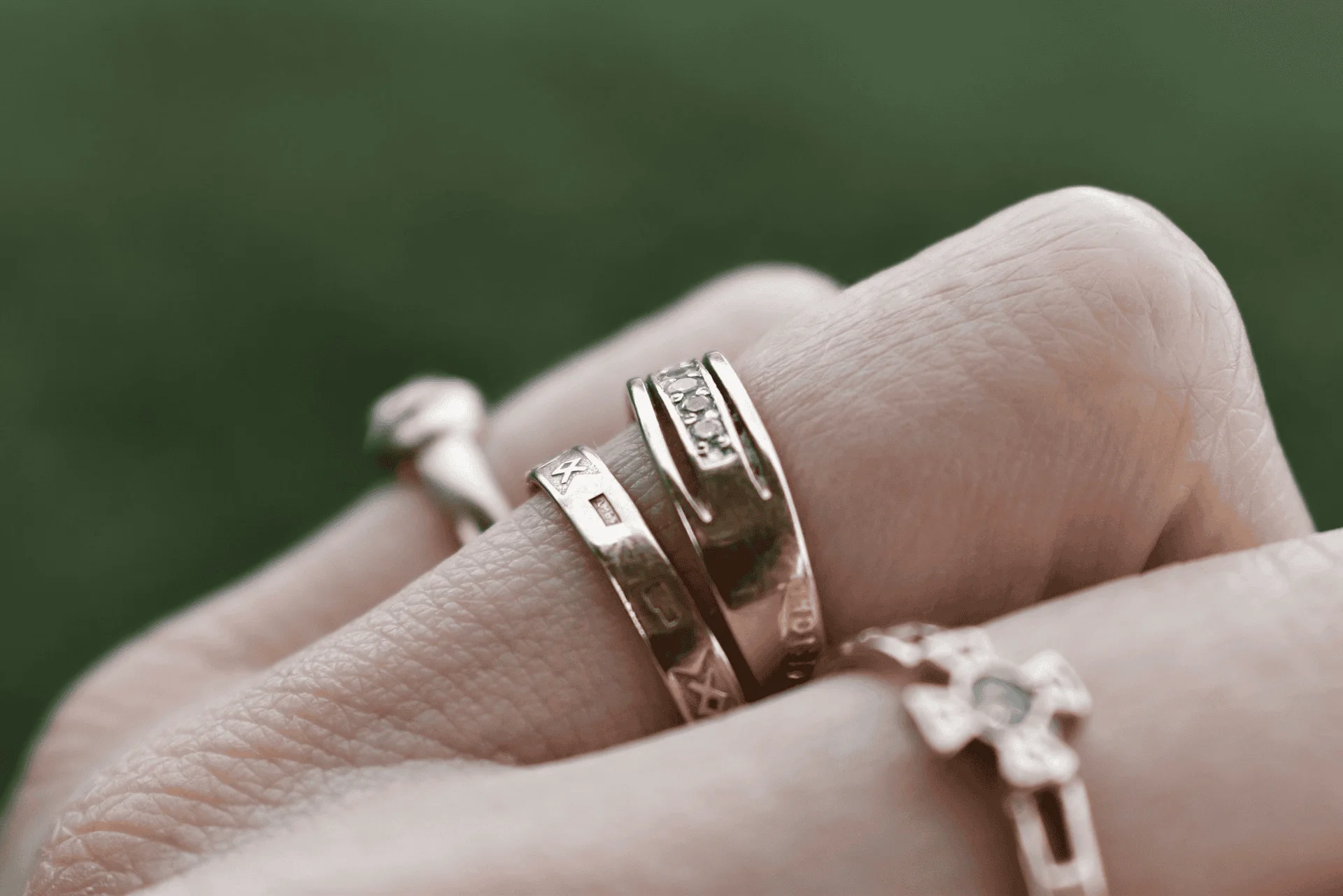
How to Stack Rings: Tips and Ideas for Building Your Stack

Knowing how to stack rings gives even a single meaningful piece a whole new story to tell. An engagement ring, wedding band, or family heirloom carries a lifetime of history, but pairing it with other pieces opens up another layer of self-expression.
Once you master the art of the stack, you can give those forgotten rings a second life in your daily rotation and shop for new pieces with your full collection in mind.
The Alloy Takeaway
Artistically crafting a ring stack starts with a few key principles: start with a statement piece and, from there, mix in varying widths and textures. We’ve got a few different sample styles to get your creative juices flowing. Browse our marketplace to find the perfect simple band, gemstone focal point, or interesting geometric piece.
What Is Ring Stacking?

Ring stacking is the practice of wearing two or more rings together in a coordinated arrangement.
You might layer several rings on the same finger, spread them across different fingers, or combine both approaches to create a stack that looks effortlessly put together without it feeling crowded.
Chances are, you already have the makings of a good ring stack sitting in your jewelry box. A thin gold band can sit alongside a gemstone or diamond ring, while a chunkier signet can add some weight to the mix.
Even a daily engagement ring or wedding band can serve as your anchor. Celebrities have been putting their own spin on bridal jewelry in much the same way; Zendaya has been spotted keeping hers minimalist, pairing her engagement ring with a simple gold band, while Kate Middleton layered her sapphire engagement ring with a wedding band and two eternity rings at Wimbledon.
How to Stack Rings: Tips and Tricks
Before you start shopping for another band, first empty your jewelry box. You may be surprised by how differently a ring looks when paired with pieces you normally wear on their own.
1. Start with one anchor ring
Your anchor ring should be one that naturally draws the eye, typically your boldest, or your most sentimental or visually distinctive piece. It could be a solitaire engagement ring, statement or cocktail ring, signet, vintage piece, or colorful gemstone ring.
This base ring therefore establishes the “theme” of the stack, which the other rings can follow through their color, shape, texture, or proportions.
If you choose a diamond solitaire as your base ring, let it shine by pairing it with a thin gold band and an understated pavé band for added contrast and detail without stealing focus.
Tip: Don’t crowd statement rings onto one finger. Spread bolder pieces across different fingers or hands so each has room to stand out.
Still looking for the anchor ring that will pull your stack together? Explore our marketplace, where fresh finds are regularly added to our curated collection of pre-loved fine jewelry.
Our experts handpick high-quality gold and precious-metal pieces across vintage, antique, estate, designer, and contemporary styles. We authenticate and test every ring for precious-metal purity using non-destructive XRF analysis before listing it for sale.
2. Mix different widths and proportions
Mixing ring widths gives each piece enough definition to stand out while still looking like part of a unified stack.
A simple way to do this is to vary the visual weight. For example, pair a slim eternity band with a medium-width rope ring and a wider engraved band.
Different proportions keep rings visually distinct, rather than creating one continuous block of metal. You can also vary the size of other details, such as the stones, settings, or decorative elements, rather than relying on band width alone.
You don’t have to get the proportions right on the first try. Keep these tips in mind as you experiment with different combinations:
- Avoid extreme weights. Stack several similarly heavy bands, and the combination can quickly look bulky. Go too far in the other direction with nothing but ultra-thin bands, and the individual rings can start to blend into one another.
- Play around with the order. Move the widest ring from the middle to the bottom, for instance, and the whole stack can instantly look more balanced. Before ruling out a combination, shuffle the order and see what happens.
- Consider finger space. Wider bands take up more room and can feel tighter when stacked. If you have shorter fingers, try fewer or narrower bands so the stack doesn’t crowd your finger.
- Watch for the “one giant ring” effect. If your stack starts looking more like one extra-wide ring than several distinct pieces, swap one heavier band for a thinner one.
3. Vary textures and details
Varying textures is one of the easiest ways to create contrast between stacked rings, even when every piece is the same metal color.
Try placing a smooth, polished band beside a hammered or textured one to give each ring more definition. A rope or twisted band can add depth through its raised pattern, while a pavé diamond band or gemstone ring can bring some sparkle or color into the mix.
You don’t need all of these in one stack, of course. Even one change in finish or detail can keep neighboring rings from visually blending.
This is also where vintage and estate jewelry can come into its own, with distinctive engravings and motifs you don’t often see on contemporary pieces.
If you’re not going for a maximalist stack, though, give that detailed vintage piece some breathing room by keeping the rings around it simpler.
4. Mix metals and gold colors intentionally
Mixing metals and gold colors can add another layer of contrast and make a stack feel more personal. The key is making the mix look intentional. Keep these pointers in mind:
- Pair warm tones with warm tones. For example, try a yellow gold cigar band beside a rose gold ruby or morganite ring. Warm-colored gemstones also tend to pair well with yellow and rose gold.
- Use warm and cool metals for contrast. You could pair a yellow gold dome ring with a white gold sapphire ring, letting the blue stone and white metal provide a cooler counterpoint to the yellow gold.
- Repeat a metal color. If one color looks stranded, repeat it elsewhere in the stack. A yellow-white-yellow combination, for example, creates a balanced A-B-A pattern.
- Let a mixed-metal ring connect the two. A two-tone ring of yellow and white gold can sit between separate yellow and white gold pieces and visually tie the colors together.
- Work with all three gold colors. With this much color variation, keeping another element consistent, such as similar widths or simpler designs, can stop the stack from feeling too cluttered.
Of course, there’s nothing wrong with sticking to a single metal or gold color.
If your style leans toward quiet luxury or minimalist jewelry, an all-yellow-gold or all-white-gold stack can create that cohesive, understated finish. At the same time, you experiment with widths, textures, and details instead.
5. Consider ring geometry
In other words, look at how their shapes physically fit together. Two rings can look perfect side by side in your jewelry box yet push against each other or leave unwanted space once worn.
Start by looking at the profile of your anchor ring. A straight band will often sit flush against another ring if there’s enough clearance beneath its setting.
On the other hand, a low-set gemstone or an unusually shaped center stone can block a straight band from sitting close, leaving a gap between the two.
That space isn’t necessarily a problem, though. In fact, a little negative space between rings can become part of the design.
If you prefer a closer fit, several ring shapes can wrap around or follow the outline of the ring they’re paired with:
- Curved bands bow around a protruding center setting.
- Chevron and V-bands create an angular opening that can frame a center stone.
- Wishbone rings form a softer V shape and can nest around engagement rings or other prominent stones.
Beyond how closely the rings sit, pay attention to where they touch.
Two pieces may technically fit together but still be a poor match if they’re constantly rubbing against each other, gradually wearing down or causing unnecessary damage.
If you’re buying both an engagement ring and a wedding band and specifically want them to sit flush, a coordinated wedding ring set can save you the trial and error of finding pieces that fit together properly.
6. Leave some breathing room
If one finger carries a large stack, keep the fingers beside it bare or give them something simpler, such as a single thin band.
Likewise, if your left hand is carrying the bolder stack, your right hand doesn’t necessarily need to compete, unless that’s what you’re going for.
An idea borrowed from art and design is the rule of odds, where an odd number of elements can at times feel more visually balanced than an even number. Applied to ring stacking, that suggests starting with three rings on one finger rather than two or four.
Don’t get hung up on the number, though. It’s not a strict rule. Two, four, or more rings can look every bit as good if the proportions and placement work together.
Tip: Once you’ve got everything on, take a look at both hands together rather than judging each finger on its own. If the overall arrangement looks balanced, you’ve got it right.
7. Make sure the stack is comfortable
What good is a ring stack you love looking at if you can’t wait to take it off? Once you’ve found a combination you like, wear it for a while and ask yourself:
- Can you bend your finger comfortably? Your rings shouldn’t restrict normal finger movement or pinch your skin when you make a fist.
- Do any rings dig into the fingers beside them? Wider bands, raised settings, and decorative edges can become uncomfortable where your fingers meet.
- Are the rings spinning excessively? A ring that constantly turns may be too loose or may be getting pushed around by the rings beside it.
If something feels off, don’t assume you need to resize every ring right away. Try rearranging them first. Your finger isn’t the same width from base to knuckle, so moving a wider or tighter-fitting ring higher or lower within the stack may change how the combination sits.
You can also remove one band, swap a wider piece for a narrower one, or reduce the stack’s overall height to give your fingers a little more room to move.
Ring Stack Ideas to Try
Use these ring stack ideas as formulas, then borrow the earlier principles of color, proportion, texture, and placement to make each one your own.
The classic gold stack
Keep the metal color consistent and create contrast through width, texture, and detail instead.
- Polished + textured: Pair a wide polished yellow gold band with a slim rope ring and a lightly hammered band to vary the surface texture.
- Thick + thin: Use a medium-width gold ring as your anchor, then place narrower bands above and below it so the stack doesn’t read as one solid block of gold.
- Seasonal gold: Warm yellow gold pairs especially well with autumnal gemstone colors such as garnet, citrine, or smoky quartz if you want to change up the stack with the seasons.
Engagement ring and wedding band stacks
Let the engagement ring establish the shape of the stack, then choose bands that complement its setting.
- Solitaire + pavé: Pair a solitaire with a slim pavé wedding band so the center stone remains the focal point.
- Low-set stone + curved band: If a straight wedding band leaves an awkward gap, try a contoured, chevron, V-shaped, or wishbone band that follows the engagement ring’s profile.
- Framed bridal stack: Place the wedding band below the engagement ring and a slim anniversary or half-eternity band above it for a three-ring arrangement.
- Intentional gap: A small gap between your engagement ring and wedding band can become part of the design if the proportions look balanced.
The diamond ring stack
Vary diamond size, setting, and coverage to add sparkle.
- Solitaire + micro-pavé: Let a larger solitaire act as the anchor and add a delicate micro-pavé band underneath.
- Eternity + plain spacer: Place a slim polished gold band between two diamond bands to interrupt the sparkle and give each piece more definition.
- Mix diamond shapes: Pair an emerald-cut diamond band with smaller round brilliant diamonds to create contrast through shape as well as size.
The mixed-metal stack
Use repetition and color relationships to make different metals feel like they belong together.
- Yellow + white + yellow: Place a white gold diamond band between two yellow gold rings to create a simple A-B-A color pattern.
- Warm + warm: Pair a yellow gold cigar band with a narrower rose gold ring for a softer color shift.
- Gold + platinum: Pair yellow gold with platinum when you want a stronger warm-cool contrast.
- Two-tone bridge: Place a mixed yellow-and-white-gold ring between separate yellow- and white-gold pieces to connect the two visually.
The vintage and modern stack
Use differences in age, craftsmanship, and finish as the contrast rather than trying to make every ring look like it came from the same collection.
- Engraved + polished: Pair an ornate vintage gold ring with a clean polished contemporary band so the engraving has room to stand out.
- Art Deco + minimalist: Let a geometric Art Deco ring lead, then surround it with narrow, undecorated bands that echo its lines without copying them.
- Vintage gemstone + modern gold: Pair an estate sapphire, ruby, or emerald ring with simpler contemporary gold bands, letting the gemstone supply most of the color.
The minimalist stack
Keep the number of rings, colors, and decorative details restrained, then make subtle changes in proportion.
- Three thin bands: Combine three narrow bands with slightly different widths or profiles.
- One-metal palette: Stick entirely to yellow, white, or rose gold and vary polished, brushed, or lightly textured finishes.
- Bare-finger balance: Stack two or three rings on one finger and leave the neighboring finger bare.
The statement stack
Choose one ring with bold visuals, then give it enough space to stand out.
- Cocktail + slim bands: Pair a colorful cocktail ring with one or two narrow plain bands so the gemstone remains the anchor.
- Chunky signet + negative space: Wear a substantial signet on your index or middle finger and leave the neighboring finger bare before adding another ring farther across the hand.
- Seasonal gemstone: Swap the focal piece with the season, such as brighter turquoise or aquamarine for summer and deeper ruby, garnet, or emerald tones for fall and winter.
- Two statement pieces: If you want to wear another bold ring, move it to the opposite hand rather than stacking both pieces.
Build Your Ring Stack With Authenticated Pre-Owned Fine Jewelry

Looking to add a few more pieces to your arrangement? Our marketplace offers curated pre-owned fine jewelry without traditional retail markups. We hand-select high-quality, solid gold pieces specifically to offer shoppers genuine fine jewelry at more affordable prices without the retail markup.
Our curated collection brings together pieces ranging from Victorian and antique designs to vintage, estate, designer, and one-of-a-kind finds. And authenticity doesn’t have to be in question. Our experts test precious-metal purity using X-ray fluorescence (XRF) analysis, which can determine a piece’s metal composition without damaging it.
Browse our collection today and find that missing piece to complete your ring stack!


