
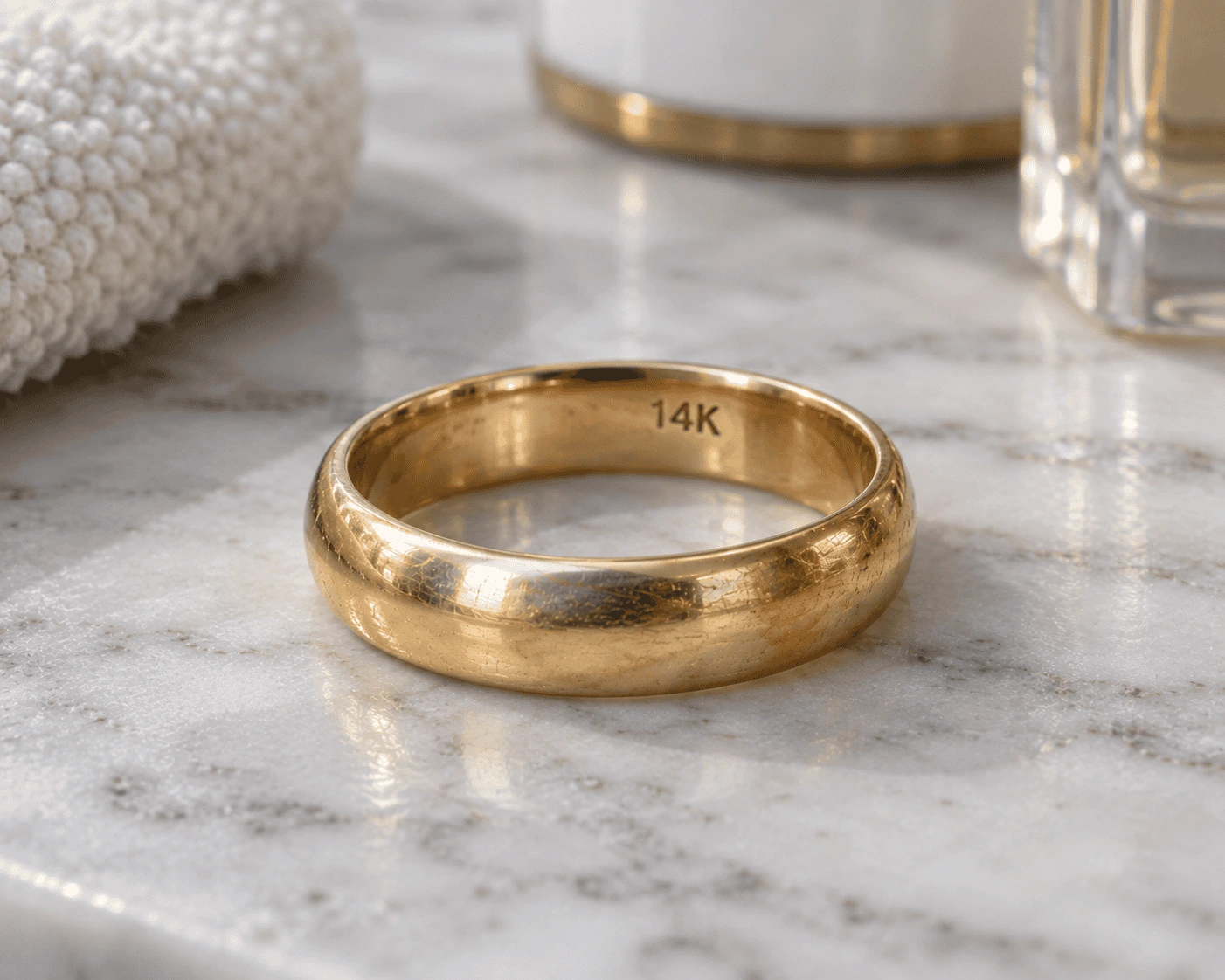
Will 14K Gold Tarnish? What You Need to Know


You’ve probably seen those images of unsightly dark or reddish patches appearing on gold jewelry. So it’s only reasonable to ask: will 14K gold tarnish?
Short answer? Yes, it does tarnish, as does gold jewelry in other karats. It’s simply a natural consequence of the alloying metals it contains. Thankfully, it’s only a surface-level aesthetic issue you can easily clean away, leaving the piece looking as good as new.
Understanding what 14K gold is made of and what causes it to tarnish can help you slow the process and keep it from coming back too soon.
The Alloy Takeaway
Yes, 14K gold can tarnish slightly because of the alloying metals in the piece. However, you can easily remove that tarnish with a gentle cleaning, bringing the piece back to its original condition. Despite 14K gold’s slight tarnishability, it remains a solid choice for everyday jewelry because of its strength and wear resistance.
Does 14K Gold Tarnish?

Yes, 14K gold can tarnish, and its composition is the main reason. A typical 14K gold alloy is 58.3% pure gold, which is tarnish-resistant. It’s the remaining 41.7% of alloying metals, such as copper, silver, zinc, and nickel, that can react with substances in the environment and result in tarnish.
These non-gold metals are a necessary addition to make 14K gold jewelry harder and more durable for everyday wear.
To be fair, other gold jewelry karats can also tarnish because of these alloying metals. But how prone they are follows a simple rule: the higher the gold content (i.e., the higher the karat rating), the greater the resistance to tarnishing.
| Gold Karat | Gold Purity | Alloying Metals | Relative Tarnish Resistance |
|---|---|---|---|
| 24K | 99.9% | 0.1% or less | Highest tarnish resistance, though not a common karat for jewelry. |
| 22K | 91.7% | 8.3% | Very high tarnish resistance, but can scratch and bend more easily. |
| 18K | 75% | 25% | Highest resistance to tarnishing among common jewelry karats. |
| 14K | 58.3% | 41.7% | Moderate tarnish resistance. Good balance of gold value and durability. |
| 10K | 41.7% | 58.3% | Lowest among these karats, as alloying metals make up more than half of its entire composition. |
Factors that cause tarnishing in 14K gold

Several factors can cause or accelerate gold tarnishing. These include:
- Sweat: Perspiration contains salts that can contribute to tarnishing of the alloying metals. As such, it often happens on jewelry worn against areas that sweat a lot, such as necklaces. 14K alloys with a high copper content are even more prone to tarnishing, since copper is highly reactive.
- Daily wear: The more frequently you wear 14K jewelry, the more you expose it to sweat and other environmental factors that can accelerate tarnishing.
- Moisture and personal-care products: Likewise, substances like sulfates found in some soaps and shampoos can contribute to discoloration over time. That’s one reason we don’t recommend wearing your jewelry in the shower.
- Chlorine: Swimming pools in particular contain high levels of chlorine, which can chemically attack the alloying metals in 14K gold and cause tarnishing and even pitting.
- Soldered areas: Solder can be found where a ring shank has been joined or repaired, as well as at certain joints in chains and clasps. These solder alloys contain varying amounts of silver, copper, zinc, and other metals, and so may tarnish earlier than the rest of the piece.
What does gold tarnish look like?
Tarnish appears as surface discoloration in shades of dark gray, black, brownish, or reddish, depending on the metals alloyed.
It can appear as a single dark spot on the surface of a 14K gold ring or pendant. Other times, it can appear scattered with no particular pattern, stretching along edges or into crevices in more intricate pieces.
Does tarnish mean your 14K gold is damaged?
Gold tarnishing can look worrisome, especially on bracelets or necklaces where tarnish can span a few inches or cover nearly half the piece. Fortunately, gold tarnish is a surface-level issue and purely cosmetic.
It’s an eyesore, but your gold’s composition remains unchanged. You don’t lose any gold content, the karat stamp doesn’t change, and your piece’s intrinsic gold value stays the same.
Why Does Some 14K Gold Tarnish Faster?
Plenty of factors explain why your 14K gold piece tarnished much sooner than somebody else’s. You may be wearing yours more frequently, perhaps in an environment with moisture and other tarnish-causing elements. Or your sweat chemistry may react more readily with the alloy.
Among these factors, one that’s worth a deeper look is composition. Two pieces can both contain 58.3% pure gold and carry the same 14K stamp, yet differ substantially in the remaining 41.7%.
In fact, jewelers can adjust the proportions of different metals in this non-gold portion to produce the gold color you prefer.
Take 14K rose gold, with one typical formulation being 58.3% gold, 32.5% copper, and 9.2% silver. Nearly one-third of the entire piece is copper, the metal behind its pinkish-red hue.
Copper-rich alloys can be more susceptible to reddish, brown, or dark discoloration from oxidation. As such, rose gold may be more prone to tarnishing compared to, say, a 14K yellow gold formulation containing 58.3% gold, 30% silver, and 11.7% copper.
Can 14K Gold Tarnish Even If You Never Wear It?
Yes, your 14K gold piece may still tarnish even if you intend to keep it tucked away in a jewelry box for a long time.
In fact, the Gemological Institute of America (GIA) published a study examining 99.9% pure gold pieces that developed red, brown, and black tarnish after prolonged storage. It shows that even pure gold can discolor while sitting idle.
Sure, you may keep your jewelry away from many of the elements it would otherwise encounter through everyday wear. But where and how you store it can still contribute to tarnishing.
For example, storing your jewelry in a humid bathroom isn’t ideal, since you’re regularly exposing it to moisture. The same goes for putting it away while it’s still damp or covered in sweat and residue from personal-care products.
Is There Tarnish-Free 14K Gold Jewelry?
Technically speaking, no 14K gold jewelry is completely immune to tarnishing. In fact, all gold karats can tarnish because the piece contains alloying metals. 24K gold, of course, comes closest to being an exception, as it contains only trace amounts of other metals.
It is more accurate to think of pieces marketed as “tarnish-free” as highly tarnish-resistant. Many of these products are treated with anti-tarnish coatings, essentially placing a protective barrier between the solid gold surface and tarnish-causing elements in the environment.
Sometimes, “tarnish-free” also comes with the label “affordable.” Often this refers to gold-plated jewelry with a physical vapor deposition (PVD) treatment over a stainless steel base. While highly tarnish-resistant, it’s not real solid gold despite looking the part.
You can, however, keep your item as tarnish-free as possible. Simple habits like regular cleaning and proper storage can go a long way.
How Long Does It Take for 14K Gold to Tarnish?
14K gold jewelry worn every day can go three years, even five years, without ever showing any tarnish. However, tarnishing can also show up as early as three months.
The fact is, it’s hard to put a firm timeline on tarnishing since many factors can be at play at once. One person could wear their jewelry every day for only an hour or two, mostly indoors, while another rarely takes theirs off. Naturally, the latter would face much more exposure to conditions that promote tarnishing.
Cleaning and Maintenance Tips for 14K Gold Jewelry
Tarnishing is common in gold alloys, but you can slow it down or reverse its effects. Here are a few tips from Alloy’s appraisal team to help keep your 14K gold jewelry looking its best for longer:
- Take your jewelry off before showering, swimming, exercising, or doing household chores. These activities increase the risk of tarnishing because of contact with reactive chemicals and humid environments.
- Apply perfume, lotion, sunscreen, and other products before putting on your jewelry. Give them enough time to dry.
- Wipe your 14K gold with a soft, lint-free cloth after wearing it to remove sweat, oils, and residue before storing it.
- For stubborn tarnish, give your piece a deep clean by soaking it in warm water with a few drops of mild dish soap, then gently scrubbing it with a soft-bristled brush. Whenever possible, avoid rinsing it directly over the sink to prevent a stone or the entire piece from going down the drain.
- Store your 14K gold in a cool, dry place, ideally in a closed container. Avoid keeping it in humid areas such as the bathroom and laundry room.
- When storing, keep each piece in a separate soft pouch or compartment. This can reduce metal-to-metal contact that can cause scratches and damage protective layers.
- If tarnish remains after gentle cleaning, have your piece professionally polished.
Tarnish, then, shouldn’t necessarily discourage you from choosing 14K gold. Its combination of durability, gold content, and relatively easy maintenance makes it a practical choice for everyday jewelry.
Shop Pre-Loved 14K Gold Jewelry at The Alloy Market

Pre-loved doesn’t mean settling for less. In fact, it’s the opposite: you enjoy huge savings from buying real, solid gold at below-retail prices. Plus, you’re making a sustainable choice by giving a piece a second life.
You’ll find a wide selection of affordable, handpicked 14K gold jewelry in our Marketplace, with designs spanning Victorian, Art Deco, vintage, contemporary, and Y2K styles. Our appraisal team tests each piece for precious-metal content before listing it for sale.


