
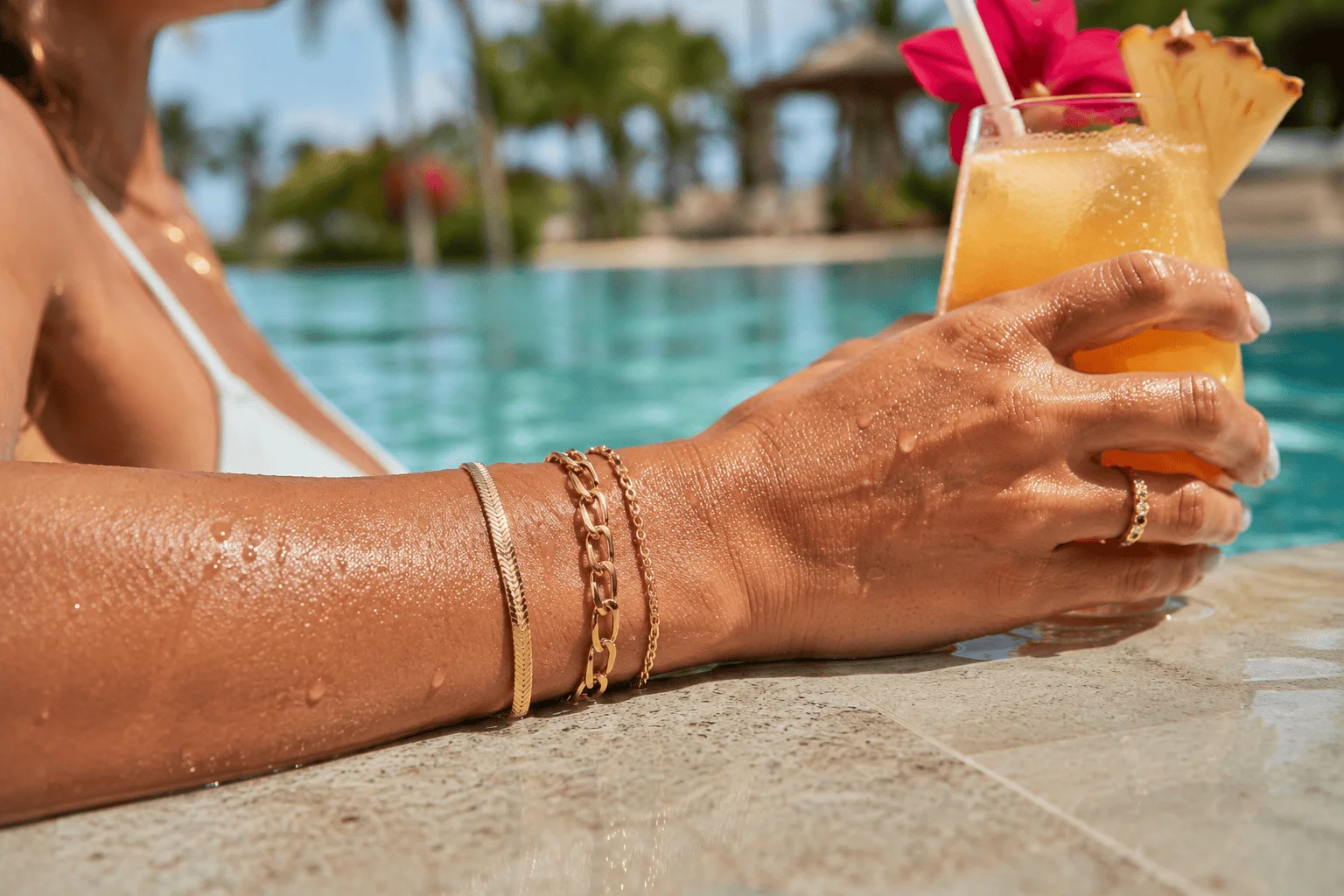
The Best Waterproof Jewelry Materials for Everyday Wear


Most people don’t want to think about their jewelry. They want to shower, swim, hit the gym, and travel without pausing to take a ring or necklace off. That’s why “best waterproof jewelry” has become such a popular search term, even though brands use the label loosely.
Ultimately, that label has become a marketing loophole that doesn’t mean much on its own. Shoppers need to consider the material and whether it withstands daily exposure to water and sweat without tarnishing, fading, or causing skin irritation. This guide breaks down each option, so you know what you’re buying.
The Alloy Takeaway
The term “waterproof jewelry” isn’t regulated, so it’s more important to look at what a piece is made of than the label attached to it. Solid gold, platinum, titanium, and high-quality stainless steel are the best materials for everyday wear because they resist water, sweat, and corrosion without relying on thin coatings.
While plated and PVD-coated jewelry can offer good durability at a lower price, those finishes will eventually wear over time. If you’re looking for jewelry that can truly stand up to years of daily use while retaining its value, solid precious metals remain the best long-term investment.
What Does “Waterproof Jewelry” Really Mean?

Jewelry isn’t waterproof the way a diving watch or a phone is. There’s no seal, no rating, and no lab test behind the claim. When a brand calls a piece “waterproof,” it usually means the metal won’t tarnish, rust, or leave a green mark on skin after coming in contact with water.
Water-resistant vs. waterproof jewelry
Water-resistant jewelry can handle the occasional splash or light moisture. Waterproof jewelry is supposed to take it a step further, standing up to full water exposure without discoloring or breaking down.
Since there’s no real standard for either term, brands use “waterproof” to signal that a piece requires little upkeep (whether that’s true or not).
That’s why checking the material over the label is a smart move. A ‘waterproof’ claim only covers water. But soap, chlorine, saltwater, sweat, and skincare products wear on jewelry just as much, if not more.
The Best Waterproof Jewelry Materials
Some metals handle water and daily wear better than others, and it’s important for you to know the difference to choose what works best for you.
| Material | Water Resistance | Tarnish Resistance | Everyday Durability | Best For |
|---|---|---|---|---|
| Platinum | Excellent | Excellent | Extremely high | Heirloom pieces, engagement rings, heavy daily wear |
| Solid gold (10K and up) | Excellent | Excellent | High | Everyday jewelry, wedding bands, investment pieces |
| Sterling silver | Moderate | Low | Moderate | Occasional wear, statement pieces, budget-friendly jewelry |
| Titanium, stainless steel, and other durable metals | Excellent | Excellent | Extremely high | Active lifestyles, minimalist “wear everywhere” jewelry |
Here’s a closer look at what gives each of these its durability:
Platinum

Our authentication lab immediately identifies platinum by its unique displacement weight. Because it is incredibly dense and chemically inert, platinum behaves differently than gold under stress. When a client brings in a heavily worn heirloom piece, the surface may appear dull from micro-scratches, but no metal has actually been lost. A bench jeweler can simply displace the metal back into a mirror finish without shaving away a fraction of a gram.
Platinum doesn’t corrode, so it doesn’t need the upkeep that white gold needs to stay bright. Its weight and density make it great for daily wear. But the rarity and purity that make platinum durable also make it more expensive than gold or silver.
Solid gold (10K, 14K, and 18K)
Solid gold resists tarnish, corrosion, and rust, and it won’t flake or peel the way plated pieces do over time. The strength comes from what’s mixed into the gold, not the gold itself. Pure 24K gold is too soft for daily wear, so jewelers add metals like silver and copper for hardness. This also lightens the color.
More alloy means harder, paler gold. 10K (41.7% pure) is the most scratch-resistant and the most affordable. 18K (75% pure) has the richest color but scratches more easily. 14K sits in between; it’s durable enough for daily wear with a warm, deep tone.
Solid gold also retains its intrinsic value. That’s why we love purchasing and repurposing your old gold, and also suggest buying solid gold over other jewelry options. When it comes time to change out your jewelry, solid gold allows you to recoup some of your investment, while plated and filled pieces will generally end up in landfills. In fact, at Alloy, we think this is one of the strongest reasons to purchase solid gold over common fast-fashion pieces.
Sterling silver

Washing hands or getting caught in a rain shower won’t ruin sterling silver jewelry. But regular exposure to chlorine, hard tap water, or ocean saltwater will lead to tarnishing.
That tarnish only sits on the surface, though. It’s copper reacting with air and moisture (nothing structural), and a polishing cloth wipes it away in a few minutes. Sterling silver needs occasional care, so it’s best for people who don’t mind it.
Titanium, stainless steel & other durable metals
Four metals dominate this category, and each trades off differently:
- Titanium is lightweight and rarely irritates skin, but resizing it is nearly impossible.
- Stainless steel costs less and can take a beating. But scuffs appear more quickly, and the nickel content may be problematic for people with sensitive skin.
- Tungsten scratches less than any metal on this list. But a tungsten ring may crack if you drop it, and jewelers can’t resize it.
- Cobalt looks like platinum for a fraction of the price. But like tungsten, jewelers can’t resize a cobalt ring.
Brands Known for Waterproof Jewelry
Plenty of brands market their pieces as waterproof, but the materials and construction behind that claim vary from one company to the next. That’s why shoppers should check whether a piece is made of solid precious metal, stainless steel, or a plated coating before buying.
Popular waterproof jewelry brands
A few well-known jewelry brands illustrate how different “waterproof” construction can look:
- Hey Harper is known for stainless steel pieces finished with a coating that bonds at the molecular level for stronger wear resistance than standard plating.
- Mejuri offers a mix of solid 14K gold, 18K gold vermeil (a thick layer of gold over sterling silver), and implant-grade titanium.
- Local jewelers specializing in solid gold work almost exclusively in 10K, 14K, and 18K gold or platinum. They’re ideal for buyers who want long-term, repairable pieces.
- The Alloy Market operates exclusively in authenticated, pre-owned fine jewelry made from solid gold and platinum. By intentionally excluding coated or plated fashion pieces from our platform, we ensure that every item across our marketplace holds intrinsic commodity value and permanent environmental durability.
What to look for regardless of brand

A trusted brand makes for a better shopping experience, but the metal itself has the greatest impact on long-term durability.
Before buying, it’s worth checking a few things:
- Metal composition: Look for titanium, solid gold, or platinum, as they resist rust well.
- Solid or plated: Solid gold looks the same for life. Plated pieces eventually wear through to the metal underneath.
- Coating thickness: Physical Vapor Deposition (PVD) fuses to the metal at the microscopic level, so it lasts far longer than standard thin plating.
- Care instructions: Brands that provide specific care advice usually design their jewelry to support that advice.
- Warranty: A lifetime color warranty or a multi-year plating guarantee indicates that the brand stands behind the product.
- Repairability: A jeweler can polish or repair solid gold and high-grade stainless steel. But they can’t fix heavily plated pieces the same way. Once the coating wears through, there’s nothing left to restore.
Solid Gold vs. Gold-Plated “Waterproof” Jewelry
Sometimes, a piece labeled “waterproof gold” turns out to be a coated base metal rather than solid gold. In fact, many customers send us waterproof gold-filled or gold-plated jewelry for evaluation, thinking it’s solid gold. Because our validation process is built exclusively for solid precious metals, gold-filled or gold-plated items are strictly rejected at our intake gate.
Our laboratory testing data show that a large volume of jewelry marketed as ‘waterproof gold’ contains negligible gold content, often less than 0.5%, masking a core of industrial brass or steel.
Solid gold is gold all the way through. Gold-filled and vermeil bond a thicker layer of gold to a base metal, while gold-plated pieces use only a microscopic coating over the underlying metal.
Understanding the differences between the options is really important so you know what you’re getting.
| Material | Longevity | Tarnish Resistance | Wear Over Time | Refinishable | Overall Value |
|---|---|---|---|---|---|
| Solid Gold | Lifetime | Excellent | Minor scratches only; color stays consistent | Yes, by jewelers | High resale and intrinsic value (the metal’s worth, separate from brand or style) |
| Gold-filled | 10 to 30 years | Excellent | Gold layer resists flaking; may thin at edges over time | Difficult | Good balance of price and durability |
| Gold Vermeil | 1 to 5 years | Moderate | Gold wears off with heavy moisture or sweat exposure | Difficult; requires stripping and replating | Moderate |
| Gold-plated | 1 month to 2 years | Low | Outer layer rubs away quickly | Not practical | Low |
Did you know?
Not every “waterproof gold jewelry” is actually gold. PVD-coated stainless steel gets its gold look from the coating, not gold content. It’s a durable, budget-friendly alternative.
Why the base metal matters
The fundamental issue with coated jewelry is not just that it loses its luster; it is that the underlying base metals are highly reactive. When water, sweat, and soap seep through microscopic cracks in a gold-plated or vermeil surface, an electrochemical reaction occurs.
The piece essentially self-destructs from the inside out. The base metal oxidizes, causing the outer layer of gold to flake off completely. Solid gold, on the other hand, is chemically inert. It does not react to oxygen, water, or daily wear. Period. It’s going to last a lot longer than anything plated.
Can You Wear Waterproof Jewelry in the Shower or Pool?
Yes, but even the most water-resistant jewelry needs care in certain situations:
Showering
Waterproof jewelry can look dull after enough showers. Body wash, shampoo, and conditioner leave behind a thin film, and hard water adds chalky mineral spots on top of that.
Rinsing it off and patting it dry after each shower can help prevent buildup.
Swimming pools
Chlorine is rough on most jewelry. A ring worn in the pool all summer often looks duller by the end of it, and repeated exposure can weaken the plating or the solder joints on chains.
Saltwater
Salt penetrates metal alloys and accelerates corrosion, while sand scratches softer stones like opals and pearls.
Letting saltwater dry on jewelry causes the most damage, so drying pieces completely (not just rinsing them) makes a big difference in protecting the metal.
Exercise and sweat
Sweat isn’t just water. It has salt and acids, which wear down plated jewelry much faster than solid gold or titanium. Sunscreen and lotion don’t help, either. They build up as residue in clasps and settings.
Why Material Matters More Than Brand
Solid precious metals are still the gold standard (pun intended) for everyday jewelry, mainly because there’s no plating to wear off in the first place.
A jeweler can polish, resize, or repair them for decades, and the color never budges. That’s why they hold their value, unlike cheap plated pieces that need replacing every couple of years.
| Category | Material | Why It Stands Out |
|---|---|---|
| Best overall | Platinum | Densest of the precious metals, hypoallergenic, and chemically stable enough to keep its white luster. |
| Best balance | 14K gold | Industry standard for fine jewelry, balancing color, durability, and gold purity. |
| Best budget precious metal | 10K gold | Higher alloy mix makes it especially scratch-resistant for daily wear. |
| Best fashion option | Stainless steel or PVD-coated jewelry | Affordable and water-resistant, with PVD forming a bond that outlasts standard plating. |
Find Everyday Solid Gold Jewelry at The Alloy Market

If you decide solid gold is the way to go to fit your waterproof jewelry needs, check out The Alloy Market’s secondhand jewelry market. We source pre-loved fine jewelry daily through our gold-buying program, and hand-select the best pieces for a new life. All items have been authenticated for purity and weight, and priced well below traditional retail. Styles vary from traditional must-haves to trendy pieces still found on the manufacturer’s website. Shop today and buy solid gold jewelry from a place you can trust.


